The key to life is not accumulation. It's contribution. Hands that serve help more than the lips that pray.

Saturday, June 20, 2020

GIN Genie 3 Light M


The new Genie 3 light harness has arrived finally. I ordered the M and the L size. I’m 1.81 cm, and 75 kg.  I tried the M size at first. 

The construction and details on this harness are amazing. I like the nice whole grey color! It changes a bit from the common black. The cloth used seems sturdy, and very well made. It does share the same construction finish with the latest Race 4! 

There's a pocket lower than the seat board that I could fit a 3 L ballast. The back compartment could fit a +10 Liter stuff and has a tie on the top. I didn’t touch any adjustments! All was fitting fine. There is a left small pocket for the relief tube. Underneath the cockpit lies a sharp cutter for an emergency. The cockpit itself is well fixed and has a high edge for preventing the sun to flare on the instruments. 
I didn’t see anything unusual to mention. It seems very well done. 
In the air, I could easily fit my self in the pod. 

The chest strap is similar to the Race 4 and is very easy to adjust in the air. 
Harnesses and tests are very difficult as we all have different height even with close weight, we don’t always share the same physical geometry. Longer or shorter legs, longer upper body…etc… That’s is why trying for yourself a harness is very important. The test can give you 50% or what to expect in body comfort and around 90 % in terms of roll comfort, and weight shift. 

The Genie light 3 has a seat board.  I personally found that the factory pod adjustments fit me exactly without any change. The back comfort of this harness offers good support and my legs were ‘naturally’ supported laying in the pod without any pressure at all. 
I adjusted the chest strap to around 46, 47 cm between carabiners, as I was lately test flying the Delta 4 MS which was earlier flown all the way with my X-rated 6 harness. 

Today, I took the Genie light 3 with some ballast to achieve 92 all up, and flew the same Delta 4 MS. To my surprise, the harness geometry of the Genie 3 light offered me an incredible turn inside the lift that I didn’t experience it earlier on the X-rated 6 I’m used to flying! The Delta 4 seems to turn even better and with more flying pleasure!  In the past, I flew several models, and I was very pleased with an old flight design sitting harness for its nice authority on the weight shift! Another good sitting harness that I regularly use for fun flying and soaring in an independence freestyle harness that offers also a very good roll. 
It that matter, I found that the Genie 3 light offers in fact a stable roll, but with a good balance for weight shift. The only harness that had this feature to my experience, was the GIN race 2! That was some harness! Every glider I test flew back then, with that harness changed from moderate agility to good agility!  I think the GIN Genie light 3 shares that amazing ABS geometry. 
I spent all my flight enjoying every moment on that beautiful weight shifting harness. 

The differences that occurred between the Genie light 2 and 3 are Practically everything…But the most important for me are: Better sitting back comfort, legs are naturally supported, more aerodynamic, nicer weight shift, fewer roll movements for the Genie light 3!  

I will try the L size, just because I felt that I have probably my shoulders slightly higher than usual. So, I’m waiting for the L size. 


https://www.gingliders.com/en/harnesses/genie-lite-3/

Friday, June 19, 2020

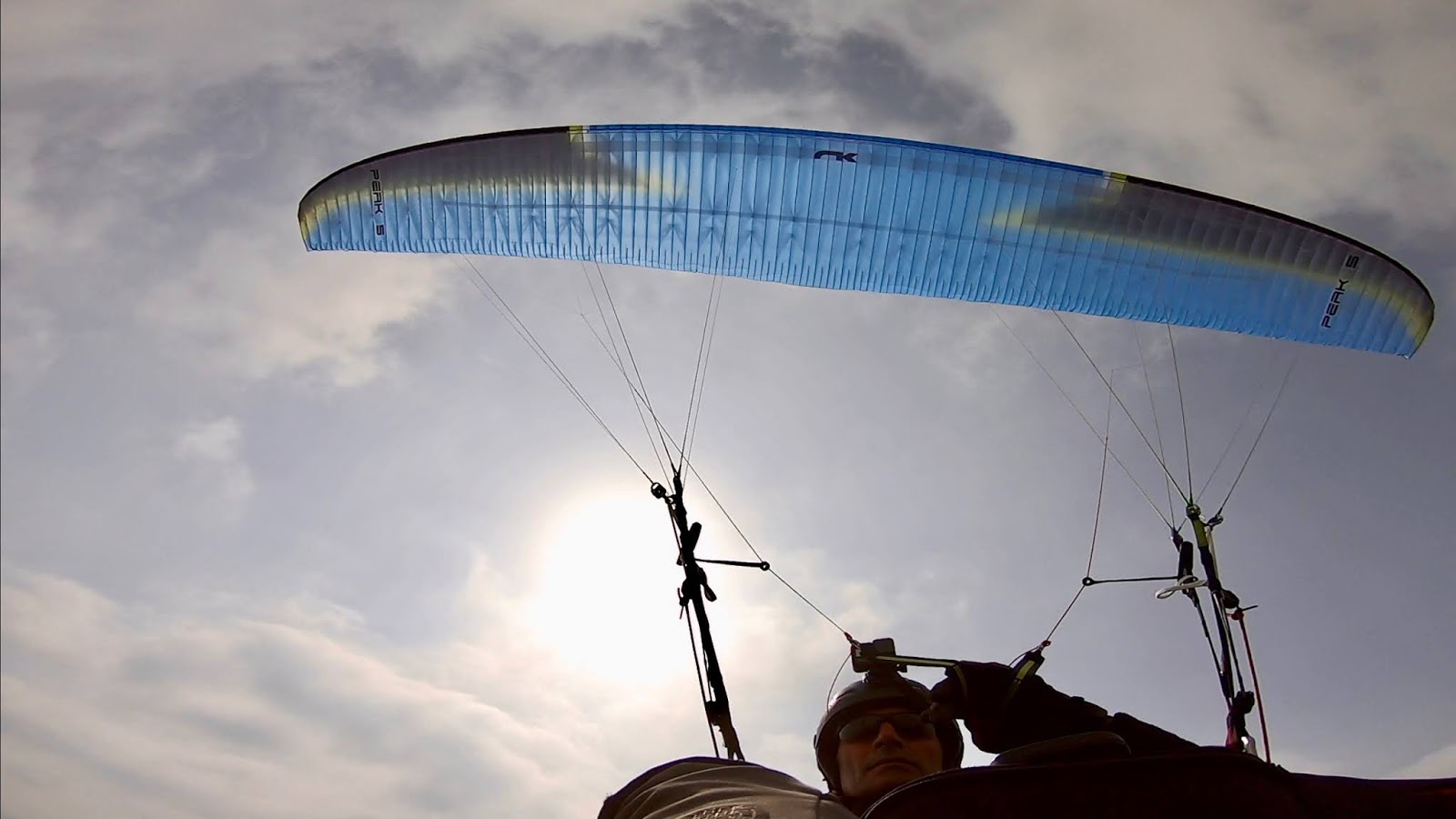
Niviuk Peak 5 22


Niviuk Peak 5 22 

I flew all the peak range from the first edition which had an amazing climb rate, the second was fast for its time, the 3rd no comment…The 4th was easy joyful accessible and a good performance package. 
Here is the 5th version with 7 AR and D certification.
The launching of the Peak 5 at 97 all up is really easy for that aspect ratio. It has a moderate rise even in nil wind. And the pilot can easily be controlled overhead. 
With my usual X-rated 6 harness, at 97 all up, the Peak 5 has a fast trim! Faster than any D available today with around +1 to +1.5 km/h faster forward speed.  Pushing the bar will allow the Peak 5 to reach around the 60 km/h mark with ease. 
I have flown that glider in weak, moderate, and turbulent conditions. At trim speed controlling the Peak 5 with B risers in turbulence needs some time to adapt as they seem light and not ‘connective’ as the other 2 liners I have tested.
 The B’s are lighter than the Zeolite, OXA3, Zeno, Leopard, Zeolite, Meru. 
 I’m not an engineer but I can feel that there is some force or pressure moving out to the front of the Peak 5 at trim, and the more I pushed the bar, the more this pressure or force is moving forward, and the less the B lines are in tension. 
The B’s control seems to have that light but spring feels, that spread horizontally.
I took my time when I had the chance to fly it, to understand that control. I’m still in the process. 
I also felt a bit less pressure toward the tips. 
At full bar, the B controls become even more light. The B’s at full bar are a bit floating. I could catch some glider movements, but it seems that the peak 5 energy and pressure keeps the glider well tensioned, and only in big turbulence, I couldn’t manage to feel anything on the B’s. Probably it’s just me, but it does surely have a much different approach than those 2 liners I already tested.  But I think that a regularly flying pilot on the Peak 5 will eventually adapt and understand these controls. 
The Zeolite for instance moves more in turbulent air. It dances all the time. But the brake authority puts the pilot most of the time in control as if there is some connection between the pilot reactions and the glider. I still didn’t find that connection with the Peak 5 yet…
The brakes were a bit long for my taste. So I shortened them by 5 cm. At full bar, there was still around 10 cm of a free gap. So there was no tension at all on the trailing edge when speed flying. 
The turning ability of the Peak 5 in moderate air, is nice.  It resembles the Meru in that matter.  Direct, agile for a 7 aspect ratio.  
In turbulent and strong air, the Peak 5 controls and authority will be slightly diminished, due to that extra power and “dominant feel” on the leading edge.  The Peak 5 dynamics within the structure and internal movements are more pronounced than the Zeno, Leopard, Meru, or Oxa3.  The Zeno felt more mellow, The Leopard and OXA3 felt more solid and compact, the Meru felt easier to understand. The Peak 5 needs time for adaptation, and will probably be much more user friendly. The Peak 5 I tested is a brand new one that my friend flew it a couple of hours. So maybe the lines could be more in place after +30 hours…I’m trying to cover all the missing links.  Smile 
Now for the performance part, I found that the Peak 5 has one of the best glides on all available D’s. The fast trim speed and the efficient leading edge when gliding through the airmass delivers enormous gliding power. I think this is the first D glider I have flown to have that much gliding efficiency!  
The climb rate in weak thermals is good, but climbing in strong thermals is really good…The ability to shoot up is really fast!   It looks like there was a volcanic explosion underneath, and the debris is going up fast toward you!   Really good in surges. 
I asked my friend who usually flies 2 liners since they had appeared, IP6, Peak 4, Zeno, Boom 11, XcTracer his opinion, and here are his comments:
Hi Ziad,
Here are my personal feelings after flying the Peak5 22 at 96.5kgs.
I’ve been flying mostly 2 liners since the IP6 ... Peak4, Zeno, Boom11, and Xcracer.
Take off is a non-event for this type of wing, goes up in one piece, good pressure, and very smooth.
I loved the handling, very linear, light, and pure Niviuk feel.
Performance is just crazy, felt at the same level as my Boom11, with an obviously lower top speed. Needs to be tested to be believed.
Trim speed is noticeably higher than other wings, but I was surprised it still has a great feeling working disorganized and wind chopped lift down low.
This wing climbs like nothing else, it bites into thermals and literally jumps up (sometimes jumps up crazy hard  Wink 
, But it always translates in lots of altitude gain.)
I had 2 tip collapses in the first 30 minutes but they totally disappeared for the next few hours in the air, even though the air got rougher... wing is very pressurized and solid, no other events but those 2 tip collapses.
Two things I did not like but would adapt to in a few hours:
B’s tension was light at trim speed and got lighter and lighter as I pushed the speed bar... something to get used to.
Not much info through the brakes, which some people like.
Crazy good high performance 2 liner but, in my opinion, needs a seasoned 2 liner pilot. 
Cheers, 
“Thank you, dear friend, for your honest opinion”
Back in my writings,  wingovers are super high!  Ears are stable and efficient! 
Conclusion:  
I’m posting here my personal feel… I think the Peak 5 needs more pilot level than the Peak 4. When flying in turbulent air, I wished for a more connection between pilot and glider ( in terms of adjusting the feedback that comes with the glider in turbulent air). 
There’s also the light B controls that I really wished a bit more feel and connection at bar…
Beside that…Its a really super machine! Super glide! , an excellent climb! quite fast and efficient! … If anyone wishes to win races on a D, the Peak 5 is the golden key, but for the emphatic and wholehearted! 
Cheers,
Ziad


Friday, June 12, 2020

Gliders and the endless search.


Hi, 
I need to share with you a bit my thoughts about the new models.
When new gliders come out in the B or C category, lots of pilots focus only on the latest models. Sometimes those models are good, but that doesn’t mean that last year's model is to be forgotten!
Or out of the equation. 
This is a very important detail, that many pilots think that if I have this new and latest model, I will do better flights! 
IMHO, that’s totally wrong, and to think that way, and follow the latest glider only, just by thinking that is an evolution for personal better flying is a big mistake many pilots do.  Of course, a better pilot will always evolve with a better model, but that is only achievable when that pilot has extensively flown his model with nearly everyday use. 

Sometimes 2 years older models could suit your flying preferences better!  One day, I had a discussion with a big manufacturer that said to me that after two years cycle, pilots don’t buy our models anymore, despite that some models are still very competitive and complete. 
Technology, research, and development are not limited by time, in a two-year cycle for example…Sometimes, it takes a year, and many times a good evolution takes 3-4 and even more…I think if we do need advanced technology, maybe we should reconsider our way of thinking about not pushing the R&D departments for a limited 2-year release. But that’s just my personal humble thoughts…

There’ s also an issue when a new glider comes out. For example, let’s take the latest Rook 3 as a B and the latest Delta 4 as a C.  They both are new and happens to be very good gliders. 
But that doesn’t mean that the other B’s from other manufacturers need to be forgotten now! For example in the B category, Rush5, Swift 5, Mentor 6, Iota2, even the Chili 4 from 2 years ago, are still at the top of the chart, and either glider can get any good B pilots for an epic XC day!  
The small differences that I found are not that important and won’t have an impact on a good B pilot. 
In the C category, the Delta 4 is a good C, but we don’t have to forget the latest Flow Fusion having a hybrid construction, with very good gliding performance, and still very comfortable in that category. There are also the 2-year-old Queen 2 and the Q-light, that delivers impressive performances, the Trango X-race, etc...and lots of other C’s that can deliver the needed requirements, and flying them is definitely not an excuse for not doing long XC’s. On the contrary, when a pilot is with a symbiosis with his glider, big opportunities will appear! 
 Many good pilots have made more than 200 Km on an A glider 10 years ago!  Imagine the potential you have in today's gliders. 
it is possible to go XC on any model if the right combination of the day's conditions and the well being of the pilot is a 100% match and that’s the most important IMHO.  
Happy flights,
Ziad 

Tuesday, June 9, 2020

OZONE Zeolite GT MS


OZONE Zeolite GT  MS

The original Zeolite was used in the latest X-Alps. Ozone released a little sturdier version, but still quite light as it weighs 3.5 kilos, the Zeolite GT.
The Zeolite GT is a 2 liner, with a little wooden handle on the B’s.
Launching the Zeolite GT at 93 all up, in nil wind is very intuitive. The glider inflates well, and fast. I think it reacts like any C glider in terms of launching. In strong air, the brake authority is present to stop the surge. 

The brake pressure is on the moderate side. Firm brake pressure, linear handling, and very good authority for a 6.7 AR glider with very few lines! Turning in thermals is quite nice on the Zeolite GT. A very good authority on the brakes that enables its pilot to have a direct response and feel. The turning behavior is surprisingly nicer than the M7 for example, in homogenous conditions. In turbulent conditions, the authority is still present but the Zeolite movements are quite pronounced, and the work on the brakes is to keep it overhead and turn later… The Zeolite never collapsed on me, not even a tiny tip! I felt it is well pressurized!  
The Zeolite GT is like a beautiful very happy Brazilian lady, dancing the Samba all the time! And sometimes in turbulent and strong air, I was a bit concerned, why is she so happy and I’m not ;-)  Seriously, it’s a very nice machine, but talks too much!
I have to add that those movements are due to that special internal light structure. The heavier Zeno doesn’t talk as much in turbulent air.  

The climb rate of the MS at 93 versus the Climb rate of the M7 MS at 93 is on the Zeolite GT side! It climbs really well!  Sometimes in headwind conditions, it seems to slow a bit before entering the thermals. So I found that better not to touch the brakes in that matter!  and to leave it fly into that airmass. Or accelerate a bit.  Just because a very slight pull on the brakes, gets the Zeolite a bit slower. 

Doing some glides with the M7 MS showed me that the glide at trim in moving air is on the Zeolite side as it floats a bit more. Pushing the first bar is also competitive, but at the second bar, I think it stays like the M7.  I felt that the full speed of the Zeolite is similar to the full speed of the M7 with the same loadings.  I can place the Zeolite between the M7 and Zeno in terms of performance. 

The pressure on the bar is moderate. The most amazing feature of the Zeolite is the B handles.  At trim or at bar, the B handles works beautifully on that 2 liner! I could steer the glider in all conditions with the efficient B handles. They stop some serious surges while on bar. If I can describe the feeling, I could say that those handles look like driving a Kart!  
Ears must be pulled from high up. They are hard to pull, but when they fold, they are stable. They reopen with pilot controls.