The key to life is not accumulation. It's contribution. Hands that serve help more than the lips that pray.

Wednesday, May 14, 2025

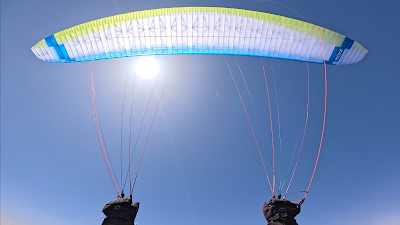
NOVA Vortex XS, Light 2 liner EN-C


NOVA Vortex XS, Light 2 liner EN-C 

After a few modifications on their EN-C Codex with its normal cloth glider, NOVA released a light 2 liner with the same aspect ratio of 6.1 
I flew the XS size that goes from 70-95 with a recommended weight of 80-90.  Here’s the link: https://www.nova.eu/en/gliders/vortex/#c16770

After some hours flying the Vortex with different harnesses ( Arrow-P, Nearbirds Zippy 3, Normal Arrow), I think the Vortex is easy to fly in all harnesses with a mild character.
Of course, you know me well, that I like to fly my gliders well loaded, I felt that at 90..92, I could get the best out of the Vortex in all conditions. It could be flown easily at its recommended weight range, but if you want a taught glider with immediate response and forward drive through a heavy airmass, then flying the Vortex at 90..91 is great. 

Launching that beautiful butterfly is super easy and flawless for a 2 liner. No shooting forward, just smooth inflation. When you kite the glider, you already feel and understand what to expect in the air from the movements and ability to be balanced overhead. 

Launching at 91 all up is straightforward. First lift the Vortex has a neutral pitch and goes through thermals smoothly without a pitch back or forward. The brake pressure when inducing a turn is on the moderate side, with a moderate length. You need around 25 cm to pull for a turn, but…with a linear response, meaning that you pull 2cm, the glider reacts, but it is still long and forgiving. It is possible to core narrow cores while enjoying every moment! The feedback comes from the risers, not the brakes.

One day, I flew that glider in strong air and punchy lifts. I was happy that I flew it around 91..92 all up. The Vortex loaded in those conditions, felt completely like a docile 2 liner C! A first 2 liner from the B class is possible and welcomed.  In turbulent air, the roll movements are tamed for a 2 liner C and as easy as on a 3 liner C (Artik7 P, for example). The A7 P that I still have over here, and fly in comparison, has shorter brakes and slightly sharper movements. The Vortex, being a 2 liner, doesn’t play in the same field of accessibility, perhaps a slight more control, but negligible…I’m only talking about pilot requirements for flying accessibility, not behavior after collapses, which I also didn’t experience when flying both gliders. 
Comparing the handling with an Ozone Lyght size S (65-85) flown at 85, the Lyght has a slightly shorter brake response for the same agility. Of course, the pilot level required to fly the Lyght is slightly above the Vortex, which seems like a lamb in comparison. 
Both the Codex and the Vortex offer the same comfort. 

Climbing next to the best 2 -liner Cs for reference, showed me that in weak climb and strong, the Vortex has good acceptable capabilities. ( I will update my C comparison for that) 

Doing some long glides with my reference glider, I saw a big potential in gliding power, mostly in calm air. The other 6.5, 2 liner machines had a slight advantage in a moving airmass. But for me, the Vortex was more than needed if I’m not racing toward a goal at full bar, or competing with a Lyght or Photon for the serial class. The Vortex got me everywhere I needed to be with a more comfortable ride and, most importantly, a light package! 
The B handles are slightly on the firm side, but ok for the XS size I'm flying. 

Ears are best done with outer A’s , because they are stable with an efficient sink rate! Playing around is fun, and the energy stored is high. 

Conclusion: 
The Vortex, with its light construction, compact packing, easy handling, and great maneuverability, offers an excellent package of accessible performance. for any (2-liner C class ) pilot going the light direction, especially for hike and fly, and of course, travellers!  For the majority of pilots, the 70 L outside bag containing a glider/harness/helmet will weigh from 7 to 8 kg, depending on your harness and rescue! That’s quite fun to have. 
Wishing everyone happy, safe flights and a beautiful summer! 
 

Tuesday, May 13, 2025

BGD Base 3 M


BGD Base 3 M

BGD released its new B-class glider for 2025 and beyond. Here is the BGD webpage for all the specifications:  https://www.flybgd.com/en/paragliders/base-3--paraglider-2021-2272-0.html

Since I have already flown the Base 1 and 2, I can easily describe the differences in the Base 3. 
I flew the Base 3 M (75-95) at 92 and later at 95, to realize later that the optimum weight I found myself efficient in all conditions is near the top weight ( for me 94..95) 
Launching:
The Base 3 is constructed with excellent materials, Porcher Skytex 38 and 40 /m2, which are very good and durable. Pulling on the A’s is straightforward, probably a bit slower to rise than a Rook 4, for example, that I still have here with me.  Slowly but evenly, the rise is smooth, and that’s good is strong breeze, as it gives the pilot time to react. 

In the air:
Flying the Base 3 at 93 with my Impress 4 harness and getting the first lift.
The brake pressure is on the moderate to firm side, not hard. Just firm on the lower part after 40 cm of brake travel.  The Base 3 responds very well to the brake input, which needs in turbulent air around 20 cm to turn it into a punchy core, and sometimes lowering it a bit more helps.  The authority on the brakes is good for the pilot about adding a soft feel, like you are flying a mid-B-class glider. It feels quite accessible with those brakes that give you a strange but high passive safety feel.  The brake feel and handling reminded me of the Nova Mentor 7, XS light version. 
In strong air, the pilot can place the glider easily in any core. Overall, good handling.
The Base 1 had less structure homogeneity, the Base 2 was too accessible, and the Base 3 is even more! The maneuverability is even slightly better on the Base 3. The smoothness and mellow feel are very close. 
For instance, the Rook 4 and the Rush 6 feel more dynamic, and both of them are much less dynamic than the Maestro 2. (Just to get the idea)  

Flying the Base 3 in strong air, even at 91-92, is a non-event, but not efficient to dig through, that’s why I felt that it was best to fly it at 95, to be able to compare it with other gliders like the Rush 6 and the Rook 4, knowing that all others are loaded similarly. 

Climb rate:
Let's begin with the weak climb, less than 0.5 m/s, next to my competitors.  In those weak conditions, I stayed around 2 hours with my friends and got a pretty good idea. I think the Base 3 has good climbing properties in the very weak stuff when there’s no valley breeze, just smooth weak thermals. It can get along with the two others. ( I will update my B comparison as usual for the little details if needed) 

In a little stronger thermals (2m/s) with a present valley breeze, I found out there that it would be best to load that glider at max weight to keep up with my two friends.  After some time, I think that the Rook 4 was always getting that lift, followed by the Rush 6. The Base 3, of course, managed to get through, but needed more time.  

We did lots of glides all together, in different air, and the base 3 performed acceptably in the B class segment. 

Comfort and usability:
Among all the high B’s I have tested, the Base 3 offered me the most comfortable flying I have ever seen. It looks exactly and behaves like a mid B to say the least. That Base 3 is so comfortable to fly for a 5.7 AR glider that you think something is wrong! The roll is very dampened, and the pitch is nearly absent. Flying for hours under the Base 3 is exactly like flying a lower-class glider, to say the least. 
I think this is the strongest point of the Base 3. 

Ears are stable and easy to induce.  Speed over trim is around 13 km/h. 

Conclusion: 
Perhaps the Base 3 could be easier to fly than some mid B’s! Or at least it feels the same. BGD seems to focus a lot on usability, handling, and high comfort on the Base 3, and they have succeeded in doing so. 
Flying it in strong alpine air for many pilots could be quite comforting. Please consider flying it at max weight in order to get some benefits. 

Monday, April 7, 2025

NIVIUK Hiko-P


NIVIUK Hiko P size 22

After some good learning hours on an A glider, a friend got her new Hiko and was keen to know what it would be like in comparison to another B glider. Since I can fly the size 22 at 84 all up, I got a brand new Hiko P, which is the light version of the original Hiko.
Construction and details are excellent on today’s Niviuk gliders, and the Hiko P is no different with that light cloth.
My first pink-colored Hiko with my Arrow P at 84 standing on launch.
Even in nil wind, the glider inflates flawlessly. In light wind, it's so straightforward to launch. The light fabric inflates well, and the Hiko rises above my head, waiting for me to step forward.

Usually, and 90% of the time, when I fly low-rated gliders, I don’t expect to be satisfied by the reactivity of the glider. First turn under the Hiko P and I’m already amazed by that brake smoothness and coordination. The HIko-P is an agile mid-B glider with amazing turning abilities. It can core tightly any thermal, without hesitation.
Light to moderate brake pressure, with linear and direct brake response enabled me to guide that glider everywhere I wanted in turbulence and inside thermals.
That light Mid-EN-B glider gave me and to my surprise a very nice time testing it handling-wise. A pure joy to steer in the air.

The climb rate is on the high side under that glider. Even though I was on the top end, the Hiko-P climbed very well, and I think I could place it easily among the best ones in that category. In strong thermals, there’s no high-pitch back considering that category. On the contrary, it slips through the air smoothly but, of course, slowly compared to the upper classes.
Gliding through some difficult air surprised me with the Hiko-P's ability to dig through slowly but efficiently! The Hiko-P behaves quite nicely in the turbulent airmass with a highly homogenous feel, and a very good efficient profile for a mid-B glider.
The feedback is smooth are well balanced with the right amount of feedback, without any parasital movements, letting the pilot concentrate on his flight.

Speed over trim is around 11 km/h at 900 ASL. Ears are stable, easy to induce, and efficient.


Conclusion:
For me to land with a smile on a mid-B is rare. Because when you fly higher-rated gliders that give you that extra efficiency, you will feel grounded in flying lower gliders sometimes. It wasn't the case flying the Hiko-P as it delivered above expectations glide and climb, and above all excellent handling with smoothness in turns, which resulted in a big smile after landing!
I think that glider can be flown as the main glider for (low-mid EN-B) pilots looking for a comfortable, easy to use, light, compact to pack, well mannered, hike and fly glider, without losing on performance and especially on fun!

Sunday, March 16, 2025

New gliders !!!

 There are lots of interesting newcomers!  :-)

I'm trying to get those:


OZONE Delta 5  / 2-liner EN-C

OZONE Light harness 

NIVIUK Artik R 2  / 2-liner EN-C 

BGD Cure 3  /  2-liner EN-C 

NOVA Vortex  / 2-liner EN-C 

GIN GTO 3. / 2-liner EN-C 

MacPara Eden 8 /  EN-B