The key to life is not accumulation. It's contribution. Hands that serve help more than the lips that pray.

Thursday, May 7, 2015

Gliders, tests and transparency.


Gliders, tests and transparency.
First of all, I would like to thank all the pilots interested in dustoftheuniverse blog and page.
Paragliding for me it is a ‘pure’ sport. Flying puts us in a place away from dull conversations, work problems, and daily routine life.
Being up there, focusing on the flight, visualizing the scenery, is an experience beyond fine description, where an individual would find him/herself floating in space and totally free.
The purpose of my tests is to be able to change wings, feel the difference, and share it.
To do so, I must purchase the gliders from manufacturers. That’s the best way to be free to make: Test, take the needed time, fly the glider anywhere I want, be free to compare it with any glider and discuss opinions with my friends.
Purchased gliders must be sold after, in order to get new ones.
Our custom status:
When each single glider arrives, the glider is detained by the customs. In the next 4-5 days they inform me and I must drive to the Airport that is 2-hour drive from my house, without mentioning the horrible traffic.
First visit consist to begin the terrible negotiations with the customs, then paperwork and a copy to be sent to the army in order to get a clearance paper.
After 3 days an army officer call to say that he is going to inspect the glider. After 5 days I began to call the army office to see if the clearance has been given. Once it has, I must again drive to the airport to began the clearance process.
I would wait outside the officer office 4-5 hours sometimes to wait for his signature! Got the paper signed and away now to the custom office to begin the release process and paying the customs fees (+Vat).
=  Around +500 including back and forth expenses paid, and 15-18 days delay with (a single) glider released! 
(I’m really grateful that ‘Imad’ a guy that works with me helps me with this issue)
Glider is tested and now I must sell it.
After the test, if a glider shows it’s potential on the videos and meets many pilots’ requirements, then the company, and the dealers and everyone working on this brand would positively benefit from it. I’m glad I contributed to that happiness…and the pilots who bought that glider are even happier!  :-)
As for me, I’m now struggling to sell that single used glider making sure that no dealer around the world is un-happy by his countryman pilot buying mine!
Knowing that he could have made some profits after the test selling to many other pilots…But that won’t sate his greed, sending emails to the main company as if the world had collapsed and the loss is enormous!
I will gladly send him any profit over it if occurred!
Glad that there are few alike, and many are gentlemen and professionals.
I’m not selling a new glider…Just (a single) 5-10 hours used glider. Wake up money worshipers…Think of the positive sides, rather than the negatives ones.  
Some complains that my prices are low.
With all the hard work getting one glider out, going for the tests, editing the videos, writing the tests, answering endless questions and emails, all free information to the pilots around the world, and they are available for any interested manufacturer.
Would it be fair to trade and profit after an honest opinion? 
After covering the above expenses. The prices are low, because they are also free from ridiculous profit!


Wednesday, April 22, 2015

Triple Seven Rook 2 SM


As seen on my videos, my tests are not only to show, talk, or to praise a glider. They are a ‘different’ way to insert the tested ones in the category they are meant for, and also to explain the differences and expectations in words.


Triple Seven Rook 2 SM

Aggressive back position intakes on the leading edge, Upper line cascades with unsheathed lines ,lower line cascades with thin ,very optimized covered Liros lines. Very sporty looking risers, excellent finish…That’s the Rook 2 in SM size ready for take off !

I flew the Rook 2 SM (80-100) from 94 to 98 all up in different conditions ,from weak to strong and turbulent in the company of other 2015 high-end B reference gliders and that gave me a complete idea about the Rook 2.

Launching this high EN-B overall is nice and even in +25 km/h wind is quite easy for the category .Just a dab on the brakes to keep it overhead, with a swift airborne mode.

I always alternate several new B gliders in the same day with the same conditions and of course switching gliders with my friends in respecting the loads.

Rewinding a bit…Considering that the Iota 26 moves comfortably as a block with a good, and firm authority on the brakes letting it be efficient enough in turning ability. Looking back also at the Mentor 4 S which has a slight dynamic feel over the Iota but also with relatively similar comfort and a swifter brake response over the Iota and a slightly less thermal climb capability in the weak .Both gliders moves as a block, with no parasite movements. (All in S sizes with same loadings)

Fast-forwarding now …The Rook 2 feels slightly more subtle in turbulent conditions with a very slight insignificant yaw movement before initiating a turn, like the one seen on the Queen, but surely with much more comfort . (More comfortable than a Blacklight,or Chili 3 for example to give you an idea ! )

The brakes authority on the Rook 2 SM are more linear than the Iota and the Mentor 4, enabling the pilot under, to feel the air and the movements of the glider placing it exactly where he wants and optimizing the turning radius with a flat turn ( Or a performance oriented turn ) .
The pressure on the brakes are less than the ones on a Mentor 4 S , and slightly close to the Rush 4 , which is moderate .

So the Rook 2 SM doesn’t have the agility and the dynamics in turns of the Mentor 4S.
It is similar to the Iota 26 agility, “but” with a super efficient climb rate in the weak ,putting it as efficient as the Chili 3 !
( The Rook 2 SM is a serious contender in climb rate! )

In turbulent conditions and head wind, I found that it’s preferable to load the Rook 2 SM a bit . May be (98 kg) is good for a better into wind efficiency “in racing mode”. Flying it also at 94 is also fine…Just slightly slower to dig in when facing a strong head wind.
The Rook 2 SM trim speed is slightly less (-0.5 km/h) than the Mentor 4S and Iota 26 similarly loaded. And slightly faster at trim than the Rush 4 by +0.5 km/h.

Did some long glides with some good B’s and C’s .

Rewinding a bit again…Doing glides into wind on little Xc’s with the Mentor 4S comparing it to the Delta 2 SM and Elan light 26 showed a better raw glide for the M4 S.
But in tricky conditions with weak choppy thermals, and low saves, both the Delta 2 SM and the Elan 26 always managed to out-climbed me and were well ahead.

Flying the Rook 2 SM with the same Delta 2 SM, and the new Elan light 26, showed a “close” glide performance to the C gliders (in windy conditions) for the Rook 2 SM especially when applying the bar a bit, (@ 45 km/h)
The good part is when each time we happen to get low trying to catch the small thermals bits …the Rook 2 SM was the first one out of the hole! and gliding away…

It was clear, when using the first part of the speed bar,
that a quick difference is felt and seen in turbulent glides. 


The action on the first bar did in fact smoothed the glider movements ! and i believe that the glide angle has improved over the trim speed glide ! That’s impressive !

Big ears are stable with a -3m/s with bar. They reopen quickly on release.
Wing overs and 360’s are also fun to use .
The speed over trim at 98 all up is + 14 km/h with the pulleys overlapping (Taken at 800 ASL)
The speed bar pressure is moderate on my Woody Valley X-rated.

Conclusion:
Triple Seven gliders seems to inherit the know-how and fine tuning capabilities of the Valic brothers competition background, by producing fine gliders with optimum line width and layout, and a big attention to the glide at speed !

What i have felt and seen, is a well designed, high-end B glider “with character”, up-to-date performance and a well tuned brake fan for maximizing the turning radius.
The Rook 2 isn’t a boring stiff B glider nor a lively one for sure !
The pitch movements are nearly absent. And the roll is moderate for the B class.
The tips are solid and powerful. They move sideways a bit, with the center pitch still very stable in movements.
They give a certain fragrance to the flight, which sensitive pilots might appreciate over a stiffer one.

The Rook 2 with it’s efficient climb rate, enabling low saves, and an impressive glide around ± 45 km/h will share the top places in the best efficient ones.


Tuesday, March 24, 2015

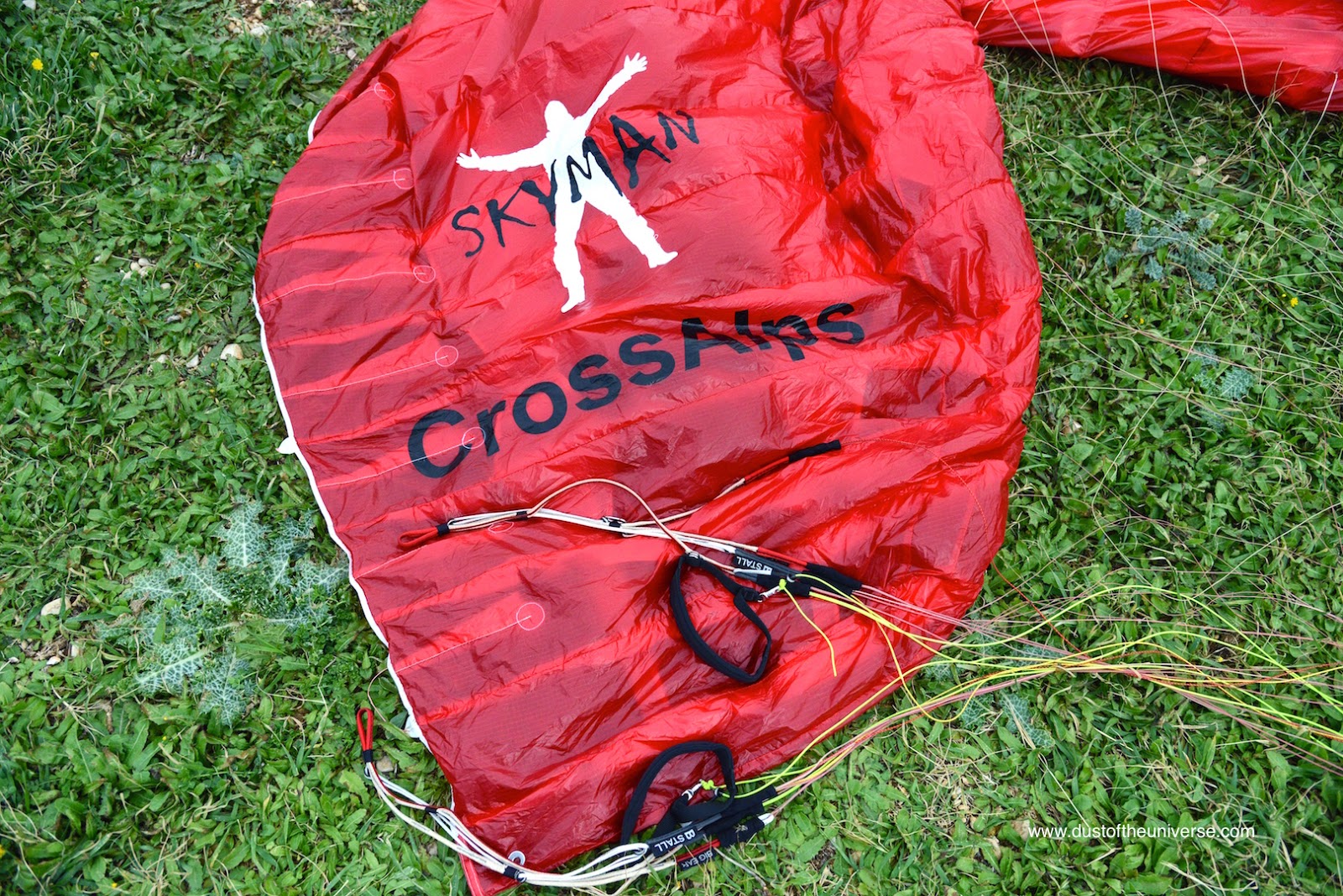
SKYMAN Cross Alps S


SKYMAN CrossAlps S

Super-light gliders…Here i come…
The CrossAlps for SKYMAN is a very light glider with a very neat construction and full of small but very important details…
I think this glider was made with ‘LOVE’ because it bears everything a hike and fly expert pilot is longing for, weather he is committed to crossing big distances supported by the thermal breeze and cool fresh air or just a peaceful minded ‘bivouac’ aficionados !  :-)

The Attachment points goes directly to the canopy, the unsheathed lines and thin dyneema risers are very well built.
The leading edge bears some small stainless steel crampons to tuck them into the snow keeping the leading edge from slipping or getting down your feet if some back wind occurs in some remote and difficult takeoffs.

I’m not the right expert to talk about that hike and fly XC machine, but anyone can appreciate a red Ferrari :-)

The take off is super easy with no wind or even with light back wind.
 Flew the S size at 89 all up. The Cross alps with it’s 6.4 ar is not a dampened glider nor an alive one. It sits in the middle of the Delta 2 SM and the Triton 2 S in terms of roll and overall movements.
The brake authority in mild conditions are very good .I could place that machine precisely where i wanted, like a surgeon doing a delicate operation.
Every centimeter result in glider adjustment ! The brakes has a relatively moderate to slightly hard pressure on the loaded S size.
12-14 cm are just needed to steer that glider.
In turbulent and strong thermals, the Cross Alps energy is more present and the authority on the brakes could block swiftly all the glider sharp movements to keep it over head.

The authority of the brakes in those conditions is slightly reduced, just waiting for the wing to settle a bit, and then coring the thermal evenly.

The strongest point of the Cross Alps is the climb in the weakest conditions !
This glider even overloaded can in fact soar and soar the sky without loosing a thermal. It is a super tool for low saves !

Doing some glide comparison with the Cross alps, puts it in the middle C in terms of glide performance.
I know that the purpose was to made a super light and compact XC glider, but the glide was just for information and the Cross Alps has lots of other benefits to look at.

In strong conditions the Cross Alps need active piloting, but it seems a solid and coherent glider if the right amount is pulled on the brakes.

The other good point is the efficient ears. Doing some big ears with the bar, i saw -5.5 m/s !!
The opening needs some time and with a dab on the brakes it opens smoothly .

For sure, the Cross alps is a very interesting, super-light XC glider to test fly ! 


Wednesday, March 18, 2015

BGD BASE


BGD Base M
The Base is the new 2015 B glider from the two time world champion and owner of BGD ,Bruce Goldsmith. The Base has lots of innovations ! From the Cord Cut Billow to the mini-ribs on the leading edge, and an aggressive big white nose ! “A new name for that famous leading edge” ;-)
Bruce often comments about the perfect angle reached with his leading edge design.
Taking off is very easy and smooth on the Base.
In the air , the Base gave me an immediate feel of a compact, comfortable , easy to manage glider for the B category. It feels more coherent and more stable than some low B’s i have tested earlier. It is definitely NOT a fully dampened boring glider . All the movements are still present but reduced to a minimum, allowing the pilot to feel every bit of lift in a slow motion way.
The brake travel is medium to short and is relatively “slightly” heavier than the recent B’s i had in my tests.
The authority on the brakes are very good .It enable the pilot to put the Base exactly where he wants, and also in a moderate slow motion way. It is not the most agile B glider, but i was fully satisfied of it’s agility ! Pulling on the brakes will immediately enable the glider to turn right where it is ordered to go.
Trim speed at 90 all up on the M size is close to 39 km/h and it’s a average to good speed for the category !
The full lengths on the speed bar enhances the speed by approximately 13 km/h over trim, and it’s relatively easy to pull with a moderate pressure like the M4 or the Iota i was testing earlier.
Applying the bar, the Base became even more solid and coherent.

Inside the B category, i found out that the Base has a very efficient sink rate in weak thermals enabling low saves !
I think the ability to slow it down and to squeeze that turn radius coupled with a very good sink rate is putting the Base among the top efficient ones.
With stronger thermals, coring with the Base by lowering the inside brake is fun to do, but the brakes get a bit heavy on the lower end.
Bruce’s philosophy was to put regular lines on the Base,instead of competition lines, for many B pilots wishing for a recreational B glider .
I did some glides with the Base versus the new B’s.
The glide in calm air or racing in strong air at trim and full bar is within the B category. The glide performance puts the Base in the middle of the B category, and it offers a lot more in climb, comfort and agility.

Ears are easy to pull, they are stable with a sink rate around -3m/s. They slowly open with a small dab on the brakes. Conclusion:
At first, just by looking at those colors will surely get you in a better mood ;-)  ! especially the River color !
The Base is a well sorted glider made for big air.
If you fly from +30 hours /year to +200 h, and your wish is a very good climbing glider that has all the latest technologies, a glider that can take you safely and comfortably in the air, a smooth and balanced amount of feedback with nice brake authority, then the Base is an interesting option to look at .


Thursday, February 26, 2015

ADVANCE Iota


Hi,
The Iota is a new B class from ADVANCE that sits between the Sigma 9 and the Epsilon 7 .
It has all unsheathed lines and all the latest innovations. The construction and the purely of the lines, is IMHO ,one of the best you'll ever see...
Launching in moderate conditions the Iota is easy and smooth. I flew the size 26 (75-100) from 92 to 96 and once airborne, the IOTA gave me a solid and confidence inspiring feeling. The comfort is exactly between the Epsilon 7 and the Sigma 9 and slightly toward the Sigma 9 . The brakes authority are slightly less than the Sigma 9 which but still direct and prompt at my loadings . The agility is slightly less than the Sigma 9 but still very satisfying.
The trim speed is fast around 40 km/h.
The IOTA moves as a whole .The structure is very coherent and the turns are initiated from the brakes rather than weight shift.
What impressed me is the gliding power of that superb machine ! I don't want to say anything more than to let you see the videos (more to come)
I think this weapon has the ability to take you wherever your mind is set to go...
The climbing and the ability to surge upward is very good and still the glider behaves very gently for the performance it delivers.
Induced collapses are soft in recovery.At least on my loadings. Big ears are stable and reopen smoothly. The speed bar takes you + 13 km/h over trim taken at 400 ASL.
Conclusion:
The IOTA will be the B glider to look at closely this season for it's 'complete ' package of climb - glide - comfort .

More to come on the IOTA 

This video below shows the potential of the 2015 high-end B gliders. It is NOT a comparison with high end D classes ,as the D class will always have the upper hand...But on a B you can fly very far...Grab a beer and enjoy this 27 mn Full HD video ! Smile
Cheers,
Ziad.

 UPDATE !
A few more words concerning the Iota.

I have been flying the Iota with lots of B gliders recently, and now i have a more clear idea about that glider.
The IOTA from ADVANCE is best flown at 95 all up on the 26. I could fly it less about 92 easily. And i did try to fly it at 98 which also didn’t affect at all the climb !

The turning behavior is as i said before not as agile as the Sigma 9 but the IOTA doesn’t dive in turns and has that stationary turn with this biting ability into thermals giving the pilot a very efficient climb rate !

Big ears are very stable and it’s efficient ! Very useful …Reopen smoothly…

Today my flying was in difficult conditions with a north wind
that reduced our trim speed to 12 km/h facing the wind.

I was really surprised that after some hours flying with the best B’s of the moment at exactly same loadings for both (96.5)  that the IOTA is a very interesting and efficient glider in difficult conditions whenever in climb or glide !
All that with a very relaxed behavior for the high end B category. I’m convinced to the point that i’m not selling the IOTA for now, and keeping it as a reference B glider for future testing.

After all …what do B pilots really need more than a comfortable, high performance B glider that can deliver when nicely asked?  :-)