The key to life is not accumulation. It's contribution. Hands that serve help more than the lips that pray.

Friday, October 9, 2020

MACPARA Magus (2020)


MACPARA Magus  (2020)


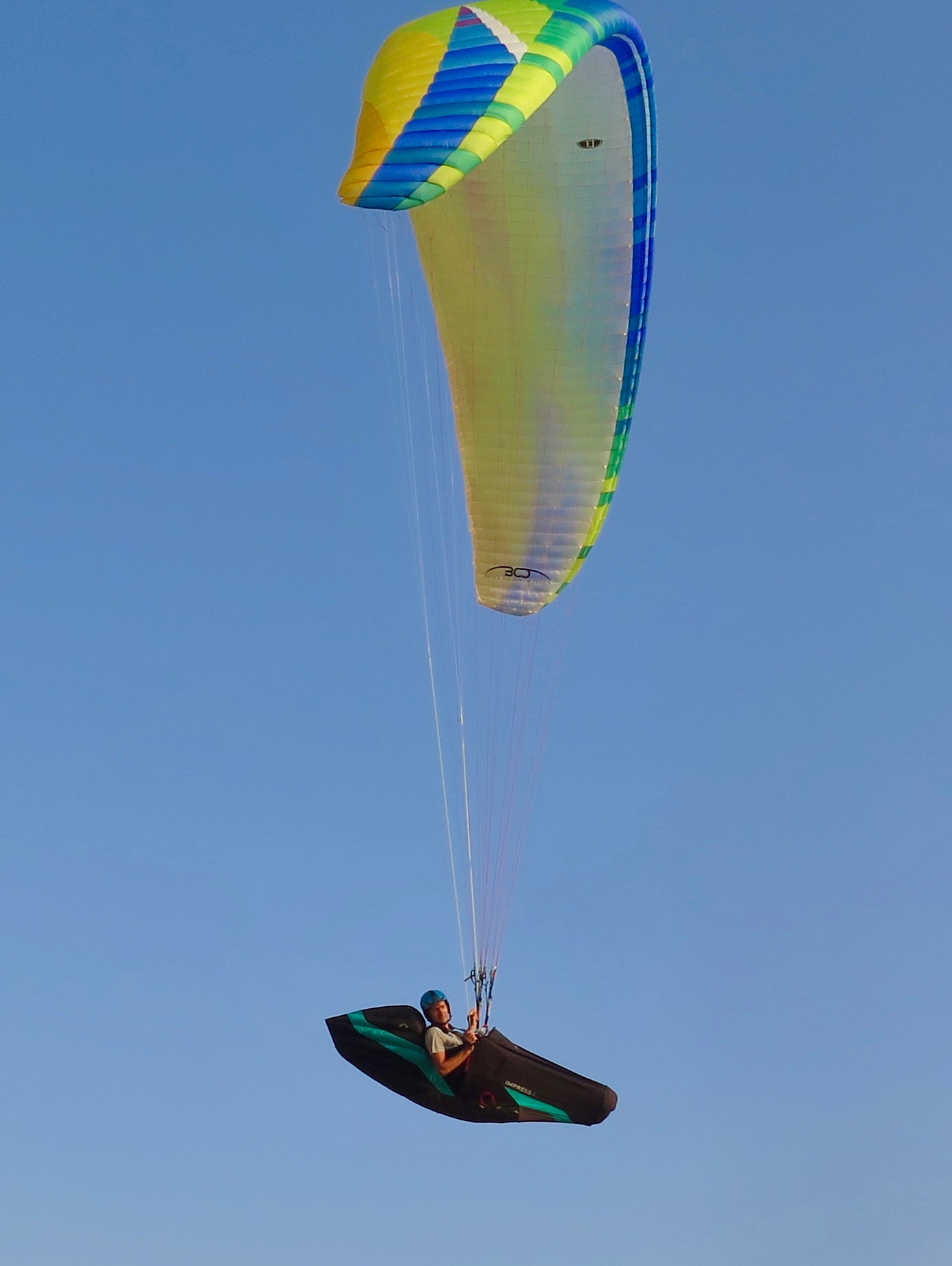
And here it is…A beautiful looking 7.05 aspect ratio, glider with 2 liner technology and an EN-D certification.


I flew the size 22 (88-99) at  97 all up with my Xrated 6 harness. 


The Magus construction seems super neat. A mix of Skytex light and heavier materials were used. 

A mix of Edelrid Aramid/Kevlar lines was used on this construction.


Launching the Magus in nil wind is a bit difficult to get it overhead. The glider must be laid down in a proper way and better to be centered when pulling the lines. Even in 20 km/h, the raise is slow but manageable for the intended pilots in that category. The Magus doesn’t snake around at all. It comes at a whole, but a little practice and patience are needed to launch it in narrow areas as we have here. 


At my takeoff weight, the Magus seems to have a fast trim speed that matches the Peak5 one with the same size and load. My first contact with the brakes gave me an early smile for that nice given authority.  I can describe the brakes to have a short, precise, and linear feel through the range for the 2 liner category. It resembles the Zeolite brake authority which puts the Magus among the best ones in the 2 liner brake authority.

I could get a short turn radius on the Magus in small bubbles, and still, be very efficient.  The pressure on the brakes are on the moderate side and won’t be tiring after some hours.  The feel of a firm precise pull is present. In very weak thermals, I sensed that I must concentrate to be efficient, but the overall efficiency of that glider enabled me to stay afloat. 

In a more homogenous thermal, the Magus climbs like a rocket. It matches the Peak 5 climb.  

I flew the Magus in different conditions. In turbulent air, It is more comfortable than the Peak 5 and slightly less than the Zeno. It is somehow similar to the Leopard in dampening behavior. 


I could confirm that I was really more than satisfied with the incredible performance the Magus had to offer!  In one particular flight, I was gliding in a very well known place for my routine flying, and gliding through difficult air, the Magus ability to float and move forward is superb…It glides really well upwind, and I experienced a very efficient upward sliding through the air! 

My god, how I miss the 2 liner efficiency! And that Magus revived my senses even more!  Flying the Zeno, OXA3, Leopard, Peak 5, is also rewarding for performance, but I must add that flying the Magus is like having your best meal with the exact spices you wished for!  At least that’s my personal feel…


Gliding next to the top 2 liner D’s at trim speed, showed me that the Magus is definitely among the best ones at the very top. 

At full bar, the gliding performance place it among the top 3 

The B handles have moderate and precise pressure. I like that! Finally, I can feel and control that Magus at bar. 

In some turbulent air, I felt that the Magus have a strong and homogenous structure, but only the tips were slightly collapsing without any consequences. I think more hours on it could clear those small cell deflations. 


Landing in tight spots can be achieved with that Magus, just because I could slow it quite well, before stalling. It is for sure a delicate matter. 


Ears with A’s are small. I need to pull them long enough to be stable. And while pushing the bar, they have around 2.0 m/s descent rate.  

The top speed is around 19  km/h over trim.  


Conclusion:  Just a small piece of information, that you probably know between 3 liners and 2 liners… Flying one of the best 3 liners of today example (M7) …etc…and flying the 2 liners Magus, is like driving your regular car then switching to your every day MAC Ferrari!  

The difference between ‘efficient feel and performance’ is breathtaking!  When test flying other categories in nice days….Imagine how I’ll miss that Ferrari feel!  :-) 


The new Magus has everything a 2 liner pilot could dream of. Nice handling, a very efficient gliding machine, that shows you proudly how well it glides through the airmass. A relatively comfortable and solid companion for XC. 

Saying all that, it is still a 2 liner that needs all the respect and the pilot knowhow to fly it with peace. 


Friday, September 11, 2020

Tuning, and fine tuning...

Dear friends and fellow pilots, 

After some years of test flying many gliders from practically all categories, I felt that I needed to share with you some important issues. 

At first, I like to point out that the tests that I do could be called "macro testing' As many of you know that these tests are made in very specific sites, that allow us to see the tiniest difference in performance between gliders. those sites offer sometimes humid conditions and heavy air with a sea breeze. And sometimes experiencing an easterly stable layer that makes an A glider difficult to handle. Those conditions could be found anywhere near the sea, like Greoliere or Gourdon in summer …etc….It’s like runners competing in the mud. The most complete athlete will prevail. When flying in different places where all those effects are not present it would be more difficult to see the difference. 


But over the years, I experienced lots of other things that I need to share with you. 

I always fly the gliders at their optimum weight load. (how do I know the optimum weight?)   Easy: When that glider will surf effortlessly at a certain load the ‘difficult ‘ airmass while being still good in weak thermals. The balance is the optimum weight. 

Usually, ninety percent of gliders like to be loaded to fly properly, but some like the Maestro and Allegro like to be flown slightly above mid-weight while staying good in moving forward.  


As many pilots are looking for performance, 90% of manufacturers are going extreme in using the line width, that offers safe usability within the certification protocols, and offers the minimalistic drag for optimum performance. 

Those lines have accurate and defined measurements, and sometimes much less than one cm of length could make a difference. Tuning them properly in order to insert that glider into a certain box (A, B, C, D, or CCC) 

I saw on many occasions that the lines on the newly released B, C, and D gliders move after 'sometimes' 30 hours! Even on some B’s! 

So, depending on the glider.  That's vercommon on 2 liners as many of you already know. 


In most cases, after 50, to 60 hours 90 % of the B, C, or D gliders have a different 'feel a different 'trim speed and in most cases, a better climb rate'. Probably the glider becomes slower and sometimes climbs better, but wind transitions also will be different and sometimes are penalized. 

I also knew that a slight tolerance of a few millimeters is permitted within the certification.  

Now, that means that tests about performance could change slightly! 


Today's gliders are very sophisticated pieces of machinery. 

And little adjustments could alter ‘slightly’ the feel and performance.  (It doesn’t matter for many! ) I know, but I must write it as it is. 


Another important issue is that when a brand new glider is released, after certification, and after some 360s and some flying hours, the lines are well placed, and that glider could offer the exact gliding properties that the company intend to deliver and a very specific dynamic behavior through the airmass.


Sometimes, I get another glider for the same brand and the same size and I find loops on the B's or on the C's! It happened to me with the Q-Light S. The first one had incredible flying properties, and the second felt slightly less. The second had a loop on the B's. After asking the manufacturer about them, they said that this configuration is more comfortable for the pilot. They were right. But the flying quality was lesser. I released the B loops, and I regained that beautiful feel. The same happened on the Mantra 7 MS. When releasing the B loops, (about +0.8cm ) the glider became more dynamic and better feel through the airmass. But it was slightly more handful to fly, and also the Q-Light S. 


The Fusion M size didn’t have a loop on the C’s. It had superb flying qualities.  The Fusion S,  I purchased for my tests, had loops on the C's when it arrived. After my test, I concluded that it was comfortable but still needed that extra surfing into the wind. 

 After 60 hours, the dealer got an email from Flow to release the C loops on his Fusion S, Light ( specially made for him).

 The feel of surf and climb in those 'macro testing' facilities were much better! The Fusion S seemed to breathe more the air and the overall performance in moving air matched the best C's of today!  


The first Delta 4 MS I had was incredibly good! It was one of the first demos that was already flown a bit at Ozone, and it flies superbly well!  The B risers were matching the A and C risers. 

The second one,  B risers were 0.2 cm lower than the A risers. The overall feel if lightly loaded (87 all up for the MS)  was a slow glider in those difficult conditions, but still sharing the top of the C category. Loading in at 94 all up, it regained that surfing upward.

The same risers configuration is on the M7. In time, or after 30…40 hours, the loop on the B link on the Delta 4 can be released. (Ozone already posted something like that on the forum, but better to ask when to release them)  That feel of a slightly liver glider will be available.

The Leopard S,  that was tested earlier, had loops on the B's. Releasing those loops on a new serial model would have altered my test! Just because it was super efficient to dig through the air, a bit more alive, and gave me more feel even in weak thermals. But those loops must be kept at least until the glider needs tuning after some hours or so...probably. (info from Gin) 


The Maestro 21 received a flawless reviewbut the size 19 was so different...and the xalps 19 was even more awkward in feel! 

I needed to share that important information with you, just to tell you that even reading very transparent tests, the result is an 80 % max performance accuracy, and could change!!!  And concerning the handling, “if properly loaded”, an accuracy of  95 % on handling and brake authority. 

I think now you must be lost! :-)  But that is the real thing… 


All those changes that could occur will sometimes get you around +/- 10 % increase or decrease in performance and glider feel and behavior. 

And again, it is probably not important at all.  But I thought it must be said.


When I choose a glider to fly for fun, all that matters for my personal taste is a performance glider that transmits “accurately the airmass and reacts swiftly to any brake input regardless of the conditions.” 

To conclude, a glider that makes me smile after landing is the one I always choose to fly in my day off    ;-). 


Happy flights, 

Ziad 


PS: Please do not alter your glider before getting a professional opinion and a yearly check is advisable.  

Saturday, September 5, 2020

ADVANCE Impress 4 M


ADVANCE Impress 4


As usual, I’m always impatient to test fly an ADVANCE harness. Simply because of that extraordinary quality of construction and exquisite finish that was made in their latest designs, and the Impress 4 is the ‘Chef-d'oeuvre’ example of what ADVANCE is offering.

For my 1.81 and 73 kg, the Impress 4 M suits perfectly my body shape, and felt well surrounded, and I can comment that I found it slightly bigger than the Genie light M, which I found myself at its max size potential. The Impress4 size M is similar to the Genie race4 M size, the Forza M, The Exoceat M, the Supair Delight 3 M.  


It seems that the Impress 4 was fabricated on a very detailed and precise worksheet.  I can speak for every detail as it seemed to be released upon a very serious study for its use. For example, the dashboard is large, very well in place, and could contain at least 3 instruments, with neat and proper holes for the wires that come from the power banks underneath which could be inserted in their respective pockets. Those details could be available in the new harnesses, but it seems that ADVANCE made them more efficient. The water release system (a large pocket at the left) is perfect as it is wide enough for inserting the urinating tube while flying if it got loose after running on take off.  Lots and lots of small but efficient features. Two rescue containers, one anti G etc…you can find all those in the manual. 


Now I like to talk about the back comfort. Sitting in the Impress 4 M with the seat-board feels around 90 % as sitting in the Impress 3 in terms of back comfort ! which is very high for a seat board harness, and probably the only most comfortable seat harness for the back and hip till date. The legs are naturally supported, and the feel is like sitting in your favorite couch in front of the TV! So relaxing to sit in. Getting in and out is as easy as it gets. 


All the adjustments are very easy to access in the air, as I could easily adjust them to my liking. 

Now about the roll movement on the Impress 4. Having flown the Impress 2 and impress 2 plus and also the Impress 3, I could describe what you will feel inside the Impress4. 

In roll feel and weight shift control, with the ability of counter-steering rough corners, the Impress 4 sits between the Impress 2 plus and the impress 3, with a slight move toward the Impress 2+ on the seat feel, having also some slight spongy feel of the Impress3. That’s the best way I could describe it to you. 


So, it’s easy, and I could feel the seat board, but not as ‘edgy’ or ‘ authority to (lock your thigh on a seat board) as the Impress 2+, Genie light 3, X-rated6, Genie race 4, for example, but good enough! 

I have to add that even if you pull the front strap adjustment that lifts your knees, the feel remains slightly less. And also your legs would not be naturally supported anymore. So it's best to sit comfortably, with legs supported, and acclimatize yourself with the Impress 4 feel. 


Saying that the Impress 4 could be the best harness to date to offer that extra mix of feelings. Lots of pilots would love to get a harness with less edge or ‘direct, straight’ lift from the seat board edge, and some would prefer that edge. It is always a matter of personal taste. Many pilots on the Impress3 would be very happy on the Impress4 as it seems to offer ‘best of both worlds’ seat and seatless harness feel even with at the seat board in! 


Having flown the harness without a seaboard, I personally would stick to the seat board as it's my personal preference. 

One thing I have to say is that when I fly my X rated 6 after some hours, and after landing, my body parts (feet, hips, etc) feel and stress a bit the movements that were present in that flight. On the Impress 4 with some rough air, my body was still comfortable enough after landing.


Conclusion: The Impress4 looks like an improved, very well made harness, and a much more detailed and neat version of my X-rated 6 with much better comfort for the back. The feedback that comes from the glider has slightly less authority to counter-steer than the X rated6, but probably well enough to be satisfied.  I only wished that the magnet that prevents the pod from opening while weight-shifting, would be slightly bigger. The ballast under the seat is small. That’s it.   

ADVANCE produced a very comfortable, very well made, impressive-looking harness with the smallest thinkable details.


Thursday, August 13, 2020

Supair SAVAGE EN-C


SUPAIR Savage EN-C

The Savage is Supair EN-C light glider, with an aspect ratio of 6.5. Thin risers, and very well reduced and unsheathed lines all over. It's a beautiful looking glider with that mix of white with red and blue stripes! 

The take-off at 94 is super smooth. Very easy to inflate, and the glider does not overshoot. 

The brake has a moderate to short travel and also with moderate agility. The brake pressure is on the moderate side. 
The Savage seems more agile than the Cayenne 6similarly loaded and less agile than the Taska, or Cure 2 M for example for the same load.  But I felt that I could carve easily every small thermal with some application.  

In rough air with 94 all up, I felt that the Savage is comfortable to fly glider regarding the Aspect ratio! It filters unnecessary movements, and the internal structure seems coherent at least in the moderate mid-day conditions that I flew in. 

It seems to give the same comfortable feel as the Cayenne 6. 
I did some extensive gliding and climbing on the Savage. 
Flying next to my friend on his Cure 2 M at 93 all up, I could say that the Cure 2 has a slightly faster trim speeded, but matching that trim speed on the Savage impressed me with top-end gliding performance!  For several kilometers, I saw that the Savage is indeed a superb gliding machine and that perhaps…it could have a slight edge in gliding power…The surprise came later when we both applied bar. The top speed of the Savage is only 11 km over trim at my load.  With the Cure 2 M matching that speed for a few km, the Savage showed me an even better glide, that could easily match the M7 glide at that speed. 
Re-starting, again and again, those full bar glides on the Savage, made me super sure about its efficiency. Bravo ’SUPAIR’ !!   :-)

I did also fly the Savage at 90 all up, and it seems slower to enter the thermals and in gliding headwind, it seems a bit delayed to surf through. So reloading it again at 94-95, it regains that forward digging. 


We also did lots of climbing or float ability tests next to a Cure 2 M loaded at 93 and Savage at 94 all up. Another good surprise here is that I was able to feel that float ability next to my friend Cure 2, to confirm later that the Savage is super efficient in weak thermals. 
One point is that coring very narrow cores take a bit of practice as the maneuverability is not as the most agile C’s, but good enough to stay up in the air.

Big ears are stable and easy to get in. They reopened with a slight brake input. 

Conclusion: 
In creating the Savage, Supair has entered the golden circle of the best C’s of the moment. 
Supair has created a high performance, comfortable enough to fly, light EN-C machine. The glide and climb couldn’t be placed but on top of that category!  
Please load that marvel at top and test fly it, if your search is toward the light EN-C.