The key to life is not accumulation. It's contribution. Hands that serve help more than the lips that pray.

Friday, January 1, 2021

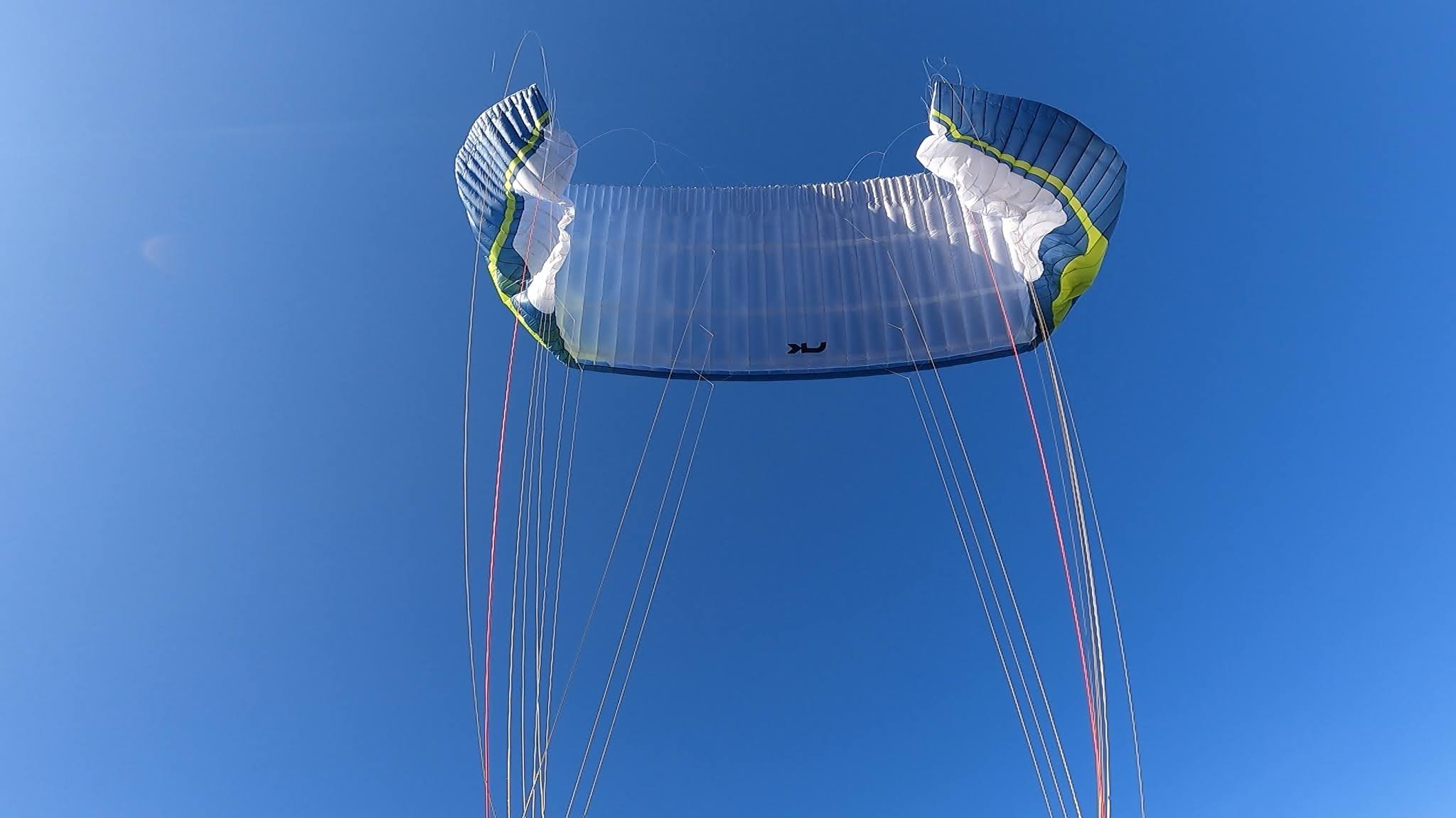
Triple Seven King 2 MS (80-97)

Triple Seven King 2  MS (80-97)

The King 2 is Triple Seven 2021 EN-D glider with an aspect ratio of 7.0 

Rods are everywhere from the leading edge to the trailing edge, even on the tips! A selection of thin unsheathed lines all across the gallery. 

Very little openings on the shark nose leading edge all across the span.

The A risers on that King 2 are shorter than the B and C ones. 


Inflation in nil wind is a challenge! So difficult to get it overhead. I tried to move my hands 20 cm higher, holding the lines. When doing so, pulling upward toward the sky as if you are helping the leading edge to rise is the best option to do. Now it is a little bit better. You need a long take off if there’s no wind! 

Inflating the glider at more than 15km/h and holding the lines higher is good. A slow rise that fills the cells and Hop you go.


Flying the King 2 MS at different loads showed me afterward that 97-98 is the optimum weight to fly it.  So i flew the King 2 MS at 97-98 in different conditions with my X rated 6 harness.

In the air the King 2 brake authority depends on the roughness of the air, when it is moderate, the King 2 can be steered perfectly into the core. The King 2 has a relatively short brake travel to steer it in the air. It is not very linear, but agile. I mean it turns quite fast if you apply the brakes, with a short no very linear feel through them. The pressure on the brakes is moderate and harden a bit after 20 cm, but I didn’t use it on all my flights. 

When it is strong disorganized and turbulent, the energy inside the glider will prevent a coordinated and swift authority on the brakes. It needs more time and application to replace it into the core. But overall it is ok. I can confirm that in most moderate air, the King 2 is an agile glider for its 7 aspect ratio.


The trim speed is very fast! In fact the trim speed at 97 matches the speed of the M7 MS (80-95) at 94 with the pilot pushing almost half the speed bar !!!  It is fast. 

Flying it in very weak thermals next to the M7 was a bit difficult to maintain the same height as it is really fast at trim to catch those very light thermals. Slowing it on the brakes won’t really matter. It is better to let it fly. But overall it stays quite ok in super light conditions waiting for the next well-built thermal to go higher. In stronger thermals, the King 2 climbs really fast. The fast trim speed helps a lot in entering that updraft quickly and move upwards slightly better than the M7. 


Gliding in the very calm air next to a similarly loaded M7 showed a little difference in gliding power for the King 2, knowing that the M7 was accelerating to match the King 2 trim speed. That difference in calm air is very little. At full bar in calm air, the same differences occurred. It is only in moving air and in headwind good XC conditions, that the King 2 showed its potential. 

Moving forward and digging faster the airmass and upward rising through the air is toward the King 2.   

The top speed is around 58 km/h taken at 900 ASL. The pressure of the speed bar is slightly hard on the second bar, but still fair. 

The B/C system can be used with ease while applying the speed bar. Smooth and efficient.

The King 2 can be considered a relatively comfortable EN-D glider. It needs more active pilot control than a Mantra 7 for example, but less than the Peak 5 for sure. And also, probably slightly less than the Zeno. 

The King 2 work in itself in turbulent air. It pitches forward slightly but doesn’t go far ahead. The roll movements are also present but comfortable close enough to a Zeno. 

Ears are doable with the outside A’s and are stable. with good sink rate. The re-inflation needs a pilot application to pump them out. Ears are also doable with the C3, and also efficient, and reopen quickly. The sink rate in both A’s and C’s are around 2.5 m/s with a little bar. 

Wing overs are super high, as it can loop only after the second turn!!! Lots of energy ! 

Conclusion:  The King 2 is made for big air and XC conditions. I don’t think any pilot will fly that glider only in very weak and stable air…It will do fine, but that’s not its strongest point. The King 2 potential is for those big windy days,  high bases, and fast transitions. The 3 line configuration of the King 2 helps a lot in getting that compact feel in strong and rough air which isn’t present yet on 2 liners. 

The overall performance of the 3 liners EN-D King 2 is reducing a little bit more the big gap of performance between the 3 liners and the 2 liners.  


Tuesday, December 29, 2020

NIviuk Artik 6 23


NIVIUK Artik 6 23

I was lucky to get that Artik 6 quickly that time! As it was impossible to purchase it from Niviuk. I’m surrounded by good positive people worldwide Smile
The Artik 6 has a nice construction. Every detail is very well finished. The risers, the sewing, the cloth…everything seems neat and well built. The Artik 6 is slightly lighter than the Delta 4. The glider’s weight sits between the Delta 4 and the Alpina 4.
Taking off at 87 all up on the size 23 (70/90) with a GIN light 3 harness is really easy. No hardpoint, no surge, just good-mannered inflation.
After some hours, it seems that the Artik 6 is as comfortable as the Delta4 MS. The pitch movements are totally absent, and the Artik 6 enters gently the rising air in moderate conditions. In stronger cores, the Artik 6 pulls you slightly toward the thermal, which is a really nice feature to my taste! The roll movements are also quite dampened and resemble the Delta 4 ones. The Artik 6 with a 6.3 aspect ratio is not busy to fly a glider. On the contrary, it is a very accessible C glider. What I really liked is the ability to cut through the airmass and move forward quite efficiently! The Artik 6 slides through the airmass with very good efficiency in gliding power.
For overall comfort, the Artik 6 is much more comfortable to fly than the Cure 2 and similar to the Delta 4.

There is a 10 cm gap before the action on the trailing edge which is quite normal, and then a refined pilot can steer it with only 5 -10 centimeters! This is quite a nice brake authority on the Artik 6. The pressure in that 10 cm is moderate. A little more brake length is needed in stronger air or sharper thermals. The Artik 6 can be turned in a very narrow core! The agility is exquisite! especially with that Genie light 3 harness. I really liked the way it turns into thermals. The second part after the 10 cm has a moderate to slightly harder brake pressure, but still very acceptable with a reassuring feel. Overall I can say that the Artik 6 handling and thermal ability are very subtle and pleasurable. As I said earlier, a sensible pilot could steer it smoothly into the air. No need to pull the brakes too long, but if done they are also forgiving.
For example, the braking length to react is much shorter than a Cure 2, or even the Delta 4. Just to give you an idea. There is a more smooth and linear feel on the Cure 2 within the brake range. The Artik 6 is slightly closer to the D4 in those terms of brake feel.
The pressure on the brakes should be measured by a scale...But I’m still trying to do it. Anyway, the pressure on the brakes of the Artik 6 is slightly higher than the Cure 2 and probably similar to the Delta 4 at the first 10 cm part.
Flying the Artik 6 23 at 87 all up, showed me that even in the weakest thermals the Artik 6 has a very good float ability. The climb in weak stuff is very efficient. The Artik 6 doesn’t dive in turns when pulling the first 10 cm part, rather than flat on the same spot! After some flying in weak stuff next to my reference C, it is clear that the Artik 6 has a very good float ability that puts it at the top of that category.
Really efficient…

Gliding through the air next to my reference C glider, showed me also impressive gliding capabilities at trim and also the full bar! At half to the full bar, a pilot will have the performance of the best C’s of today.
It seems that the Artik 6 performs better in moving air, when it can dig through the airmass move forward, and climb. A very good gliding machine for XC.
I have to mention also that pushing the first 2-3 cm on the speed bar surely increases the speed by 2 to 3 km/h, but it seems that the sink rate doesn’t decrease! So I found that gliding slightly above the trim is very beneficial for the glide.
The speed system has a C2B pulley system, that you can use while on bar. The C2B pressure is moderate, smooth to use, and efficient. The speed bar got me +16 km/h over the trim with a very good solid structure.
The Artik 6 matches the top speed of the Delta 4 with probably even a tiny edge! (Both gliders are exactly similarly loaded)
Finally inducing ears on the Artik 6 is easy and stable. I like that feature as it is also efficient to use.
What can I say…that I’m still trying to find any lesser than good points but in vain… Just because pilots would say…We only read positive comments! how boring it is !!!!
Sorry to disappoint …That Artik 6 is just ‘perfect’ !! *Try it for yourselves at the right loads!!! *

Conclusion: Test flying new machines will always result in good or lesser good comments and I really hope that one day “some” manufacturers will understand that outcome and move forward without shooting the messenger. This time I got a special and complete product, rare to find.
The Artik 6 is definitely the best Artik ever produced. Why ??? Just because it scores 9 over 10 in everything. Climb, glide, speed, stable ears, easy take-off, easy landing, high comfort, great usability, a pleasure to fly, superb agility, relatively light to carry… Against all odds, the truth has to be said clearly. The Niviuk R&D department has outdone itself.
Niviuk R&D team managed to deliver the most complete C glider in pilot demands. I test flew the size 23 and I can ‘only’ confirm that size test, flown from 85 to 89 all up. (Harness Gin Light 3 M size)
I strongly suggest test flying the Artic 6 but at a convenient load! Probably near 85% of the weight range should be in order for every pilot not to miss that beautiful and efficient machine.
Happy new year! Smile

UPDATE> Just noticed on windy days (+20km/h) when gliding upwind even loaded at the top, the A6 23 has a slight tendency to pitch back a bit when encountering a thermal and slowing down. A feeling of getting pinned a bit...

UPDATE 2 > The small dyneema lines on the whole upper galleries of the Artik 6 tends to shrink after some hours. It is best to get it for a trim after 30 hours.
My friends brakes also shrunk and the factory black dot on the brakes is now 6 cm above the pulley! after adjusting it.
Best to trim.


Thursday, November 19, 2020

FLOW Fusion Light S


FLOW Fusion Light S 


I already test flew the normal version of the Fusion in S and M size. Here’s the Fusion light version ion S size flown at 92 all up. There are loops on the C’s for that serial version, like the normal Fusion. 

Pulling on the A’s the Fusion light S comes up nicely above the pilot's head, with no effort at all. No hardpoint. In a strong breeze, a dab on the brakes to control it overhead. A really easy to inflate C glider. 


There’s a very neutral pitch feel under the Fusion light S in thermals. It enters the rising air very smoothly. The roll movements are very balanced. Quite comfortable without being too dampened. A slightly more feel than the Delta 4, but surely very comfortable to fly. I can say it felt smoother also. In the same air, where the Delta 4 could be sharper, the Fusion Light is slightly smoother with a good informative feel. 


The brake pressure is on the medium side(I’m trying to get a small scale to see how much tension (kg) on the brakes after a certain 360 turn, and it will be a new column included in the comparison tables hopefully soon).  

The Fusion Light S at 92 seems to have a relatively short, precise, and very good agility in the C category. It is a bit different than the normal version, with shorter brake inputs and more agility.  Coring thermals with the Fusion Light gave me some really nice moments, as it seems fluid inside thermals, with very good authority on the brakes to place the Fusion Light exactly where I wanted inside the core. The climb rate seems on top of that category, in weak thermals or in strong ones. The Fusion Light float ability is present and delivers smoothly its free performance for the C category pilot.


The overall movements in the air are very balanced and smooth enough to enjoy any thermal anywhere…In strong air, the Fusion Light needs control, but nothing more than a regular C pilot is required to have.  For example sometimes in moderate air, it feels as comfortable as the Delta 4 and probably smoother! The 6.3 AR Fusion Light is much easier to handle than the 6.4 AR Cure 2 for example and even easier to fly than the comfortable Artik 5. 


The glide at trim and accelerated seems also like the normal version which is also very good for the C category. The speed system has a relatively light pressure, and the new B pulley system is more manageable to control on the C’s with lighter pressure.  

 At bar, applying pressure on the wooden C risers bar will control most of the turbulence encountered, while having a cup of tea! …It is an easy, smooth, and enjoyable glider to fly for the C category. 


The top speed with pulleys overlapping is around +13 km/h over trim, with a very usable bar in turbulence. Ears are efficient and stable!  They reopened with a little pilot input. 360s are well balanced. Landing on tight spots is easy as the Fusion Light can be slowed quite well before the stall. Of course, the stall point is to be discovered in a safe environment. 

Induced asymmetric behaves like a school glider! 

I think after some 50 hours on the Fusion and releasing the C loops will have a big impact on the total efficiency of that glider. Just because the enhancement comes into wind transitions, as the Fusion with C released will surf much better the air and skip better the sinking air. Not because of the very little increased trim speed, but probably because of the ability to surf through better. The climb rate in the weak will still be very good and on top of that category. 


Conclusion: 

Flying the Fusion Light is a really cool,  rewarding experience. The handling is superb, the climb rate is among the best gliders in the C category. The glide capability is among the top 3 contenders. especially when the C loops are released.  Test flying it could lead to a long term relationship…  :-)


Saturday, October 10, 2020

OZONE Alpina 4 ML


Hi,

The Alpina 4 ML at 103 all up.
The difference between the Delta 4 ML already tested is:
-A smoother feel under the Alpina 4 ML.
-The turning behavior seems more subtle with very good agility. The brake has moderate pressure with a linear feel.
-The speed system seems to get harder to push at the second bar.
-The take-off is much...much better! Now there's no hard point on the ML.
-Ears are the same.
-Performance is the same.
-Speed is the same.
-A little better comfort in turbulence as the Alpina 4 feels more coherent and homogenous, or it is the light fabric that delivers that smooth feel.
The light fabric resembles the LM6 ones and feels lighter than the one used on the A3.
Overall...I'm impressed by that 6 aspect ratio top-end performance C glider!

Hi,
Flew it today at 98 all up on the ML (85-105) in good conditions on a +100 k run on little endless triangles ...(restricted airspace).
Surprisingly, the A4 ML at that load was entering effortlessly the airmass and moving forward. The structure was really homogenous at that load. Effortless flying and very precise handling! Still fast at trim. In headwind glides or climbing in a headwind, it was doing very nicely. But for sure, when loading it at 103 the efficiency of entering the airmass would be faster and even more efficient with even more shooting upward!
But at 98 it was really good! which is surprising for that size. And....it is very...very....comfortable !!!

Awaiting the MS and S size!

More to come soon...
Cheers,
Ziad