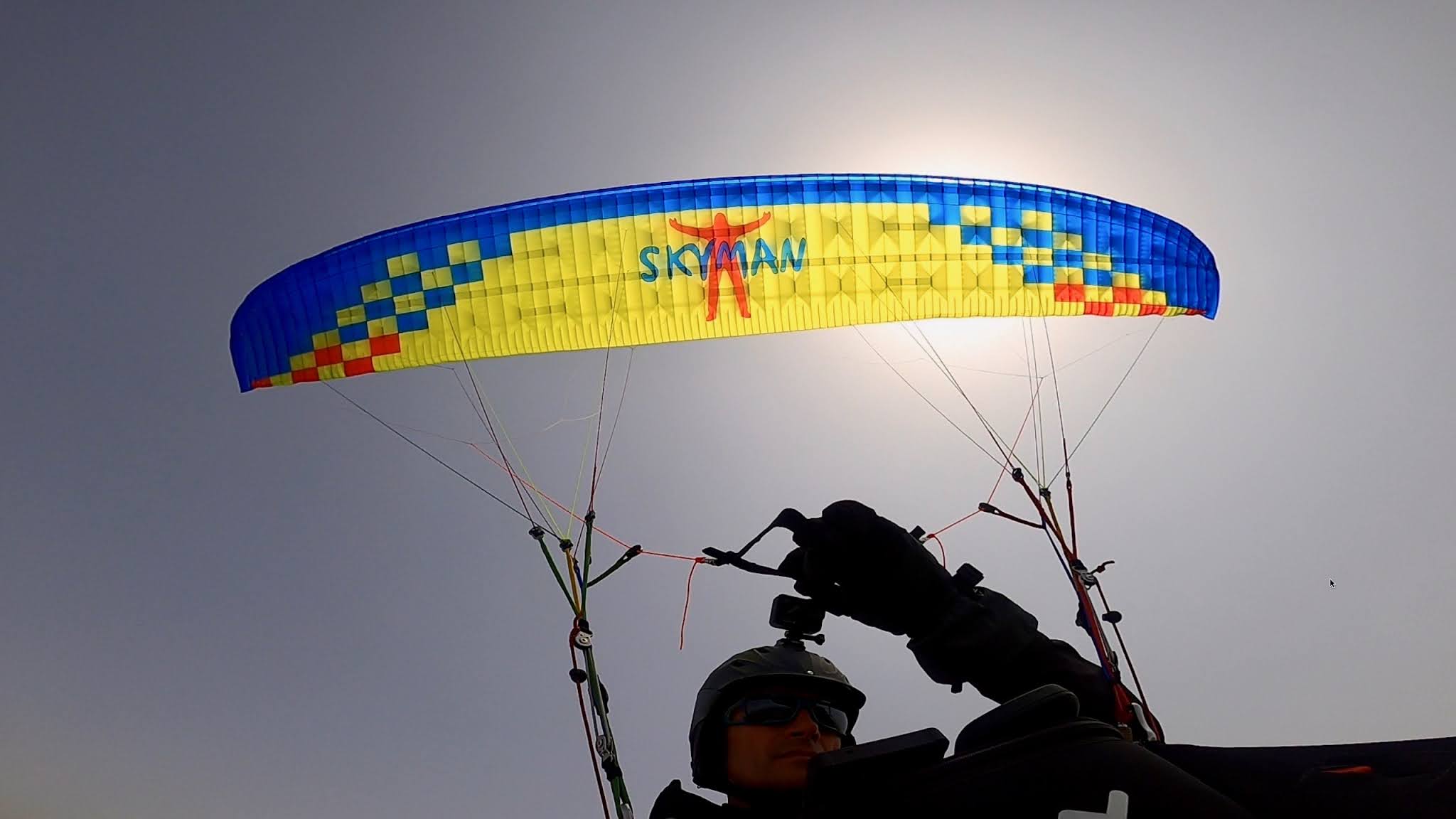
Skyman released their 2021 light EN-C. The CrossAlps 2.I have here the site 24 and I flew it at 93 all up.
The workmanship on that glider looks very neat.The light cloth seems the same used on the first version. There are some stainless steel small anchors in the leading edge to prevent the glider is sliding on snowy take-offs.
The construction looks perfect. The risers are minimalistic, colorful, and properly sewed. (see pic)
There are 2 A’s, 2 B’s, and 2 C’s!
Launching the CrossAlps is super easy, even in nil wind. It comes up smoothly and evenly.
Flying the size 24 at 93 felt very good in overall conditions.The Cross Alps despite its aspect ratio has a nice authority on the brakes! In this test, I will compare it with the Alpina 4 and mainly the Savage because of the same aspect ratio of 6.5. And will talk also about the difference between the first version and the new one.
I found out that the CrossAlps can be steered narrower in thermals with a higher authority on the brakes than the Savage.The A4 felt slightly more maneuverable than the CrossAlps, but it has an aspect ratio of 6.0.
The brakes travel felt shorter than the Savage similarly loaded, and similar to the Delta 4 MS in travel lengths.
The CrossAlps is a maneuverable glider. My C comparison is updated for the little details if needed.
In turbulence, the CrossAlps seems also more comfortable to fly than the Savage, and very close to the very comfortable A4 MS. Overall the CrossAlps seems very forgiving and quite manageable for its aspect ratio. The pitch movements are nearly absent, and the roll is very manageable and I could say quite tame for the C category.
Climb rate> Flying the CrossAlps next to The Artik 6 which has an excellent climb rate, showed me that the CrossAlps is matching the best C’s, even in very weak thermals. I was impressed by the good efficiency of thermals. Probably even slightly better than the first version which had a very nice climb rate.
Loading it at 95 would enhance the authority in turbulent air and with a neutral pitch, the CrossAlps will climb very well.
Gliding power> I made a few runs next to my reference Cs. The new CrossAlps 2 has I think a complete whole point or more over the 1st version at trim speed.And close to the good ones in the C category.
Pushing the speed bar at max, on the CrossAlps gave me around 11 km/h over trim, and could match the Savage top speed.The pressure is moderate. The glide at trim and at top speed is also mentioned in my C comparison if pilots do want to look for smaller details.
Big ears with the outer A’s are big, just because there’s only 2 A ’S. They are unstable and a bit difficult to maintain.
Landing is easy and eventful with a nice flair to land it in tight places.
Conclusion:I think Skyman has made a much calmer CrossAlps than the first version. The authority on the brakes is also smoother, less sharp, more forgiving. The ears were better on the first version. The climb rate matches the first version, but the glide is very much improved at trim.Overall the CrossAlps 2 is a more friendly user glider than the first version. Longer flights with probably 60% less workload than the 1st one!
Launching behavior on the S11 22 at 85 all up, and on the S11 24at 94 all up is about the same. The glider rises effortlessly in light wind and when the glider passes 80 % it accelerates a bit. A touch on the brakes to keep it overhead is needed and the take-off on both sizes is quick.
At first, let's talk about the size 24.
The S11 size 24 (85-100) flown at 93 all up, flies well at that weight in all conditions, and later I found out that at 97 would be great in strong air. The overall movements of the S11 seem more dampened than the S10, especially the pitch behavior. The S11 pitch seems very calm and neutral in 80 % of the conditions.The roll movement is also quite more dampened than the S10. Overall its seems to give very little in pilot demand for the C category. I think after test flying the Alpina 4 MS, the S11 24 overall movements are even calmer in the moderate conditions I flew in.
While the S10 had a little spice, the S11, 24 is calmer in moderate conditions.
The brake pressure is on the moderate side, slightly less pressure than the Delta 4 and much less than the Artik 6. To describe the linear feel and brake travel to the other C’s, I could say, that the Alpina 4 and the S10 had slightly longer brake travel, the Artik 6, 23 has shorter brake travel, than the S11, 24.
The brake authority is high on the S11, 24 as the pilot can swiftly carve the glider in the air, and it is difficult to miss a thermal core.
In biting through the air the leading edge seems to slow just a little before entering at 93 all up, but it enters with high efficiency. At 97 I found that the S11 24 has even a better efficiency into the wind.
Gliding next to a Delta 4 MS at 93 all up, I could confirm that the S11 24 at 93 has the around 95 % the same gliding power at trim and even at the S11, 24 top speed with overlapping pulleys.The Delta 4 MS had still one centimeter to push. Like the S11,24 goes to 100, and 7 kilos were missing!then the top speed will increase if loaded at the top.
Again and again, gliding with very good C’s confirmed my findings that the S11, size 24 shares equally the best gliding of the C category.
The climb rate of the S 11 size 24 flown at 93, in weak air seems also very good, as I was also next to my friends on their C gliders trying to see if there are any differences. Under the S11 the movements in very weak air ( +0.2 m/s) are very little in roll and pitch, and concentration is needed to feel the rising air.
In stronger cores, it seems that the S11, 24 climbs also really well, among the best C’s in that matter.
S11 size 22, 75/87 flown at 85 all up with a Genie light 3 M.The take-off is very easy as the glider inflates really well even in nil wind. In stronger wind, it goes up fast and a dab on the brake is needed to keep it overhead. The turning behavior with the Genie 3 is excellent. An excellent turning ability I can say! I could turn very tight with high precision. The smaller size of course is more dynamic in turns. One day the conditions were really tough at higher altitudes, and in turbulent strong cores, I felt that the S11 size 22 has a slight front pitch and the controls on the brakes lighten a bit even when pulling them at waist height sometimes.A good high B pilot reported that day when flying next to me that the conditions were quite demanding and weird. The S11 kept a solid structure in those bad conditions without even a single collapse. But it kept me busy in the air, and I could have preferred a higher authority and linear “harder feel” on the brakes rather than a light feel, to control it in those specific and strong conditions.I thought that I must top land and take another C to compare, but I was high and far to get back.
The C steering system is very easy to use and very efficient to hold the glider movements in a moderate active air while on the bar! The leading edge seems more resistant to collapse than the S10 and it felt so smooth. I let the glider fly in front of me many times, without any issues. The induced frontals and asymmetries on the size 24 are easy to recover. Big ears are stable and reopen alone on both sizes.The top speed with overlapping pulleys is around 14 km/h over trim.For more information, I did update my C comparison for both sizes.
Conclusion:The Sigma 11 doesn’t have long rods, yet it is compact enough especially the size 24 in moderate to strong air. The overall solidity is more present on the new version. The handling and overall feel seem tamer in moderate air. The size 22 needs a bit more pilot control in heavy weather.The turning abilities are superb, and the pleasure feel is high. The difference in brake authority between the S 10 and S 11 is that the S11 turns quicker with the less applied amount of brakes. The overall feedback is slightly less on the S11. Overall, it is a smoother glider to fly. I need to fly the size 24 more on strong summer days in order to be more precise, but the snow is still covering our high mountain range.A light, compact to pack, high-performance C glider is awaiting you to test fly it :-)
After the Cure 2 EN-C here is the new Base 2 from BGD. The new generation BGD gliders seems to be developed with very good software, a new designer ‘Tom Lolies’ and it seems that they are quite different from the past creations.
My friend lends me his new glider, and I flew it from 92 to 96 all up.Launching the Base 2 in nil wind requires a steady pull. It slows a bit at 45 degrees, and a little more pull to get overhead. The inflation in more than 5 km/h is easy and the take-off is immediate.
I flew the Base 2 on several occasions, and once with the company of two Rook 3 MS at the same load for all 3 gliders! 94,95 all up.
The brake pressure is on the moderate side. A bit longer than the Rook 3 or the Rush 5but reactive and linear.The turning behavior is quite good, with good agility for a high B while having a very calm character.I could turn the Base 2 inside any thermal while lowering slightly further the brakes in order to get a tight radius. Overall, I can say it has a very balanced turning ability, with no diving in turns and relatively a flat turn.At 95 all up, I could apply only 15 cm of the brake, and guide the Base 2 in an efficient flat turn, in weak conditions.
In weak thermals, it seems that the Base 2 has a very good float ability, that enables it to climb really well in the weak stuff even loaded at max weight! Facing a mellow valley breeze the pitch movements are absent and the Base 2 rises effortlessly and moves forward in the airmass. In stronger conditions, the Base 2 pitch back a little but still climbs very well when I flew it at 92 all up.That’s is why I felt that the Base2 needs to be loaded at the top all the time for good efficiency in the air, and while loading it, it still delivers one of the best climb rates in the high B category.The glider feels big, and very calm, even near the top and that’s why loading it at max felt much better.
Talking a bit about the pleasure in flight, I can say that the Base 2 handling and brake authority allows a newcomer to the high B category to understand and cope better under that machine while having fun. As for expert pilots who desire a direct feel and more dynamics on a high B, they will still feel the reactive brakes but probably will miss a shorter and sharper feel. But I think 90 % of high B pilots would be very happy with the handling and turning behavior.
The Base 2 comfort in roll and pitch is very high! I sensed that I’m flying a low B glider in that matter. The Base 2 despite the 5.7 AR, absorbs very well the turbulence and the overall movements in active air are present, informative, very dampened, and very calm. The Base 2 delivers a smooth ride all along in XC condition.The Rook 3 has more pronounced feedback in overall conditions.It resembles the Rush 5 in calm behavior.
The trim speed with the same loading as the two Rook 3 beside me is slightly higher on the Base2. The gliding in moving air done more than 4 times and 5 km glide while the Rooks pushed slightly on the bar to match my trim speed, showed me exactly the same glide as my reference in the high B category. The full-speed glide of the Base 2 which seems to have a shorter distance between pulleys, has the same top speed as the Rooks. The glide at full speed showed me also very close gliding results after 5 km the rooks arrived 5m higher…So practically the same and insignificant.
While at bar, it seems that the C steering is quite smooth, efficient, and easy to use, and I was able to control the glider quite well with total tranquility in most conditions.
Big ears are easy to hold, stable, efficient, with around -3m/s with bar. The releasing of the ears will enable the Base 2 to reopen by itself in a gradual and smooth way.
Conclusion: With the new Base 2, the BGD team has succeeded to raise the level of their products as they did on the Cure 2. BGD managed to produce a very comfortable high B, with good handling and top-end overall performance in both climb and glide. I believe that those new high B’s can get their owners to new dimensions and long XC flights while being easy and relaxing to fly. That combination of performance and accessibility is the strong point of the Base 2, and I think it will be quite interesting and rewarding for pilots to test fly it.But please remember to load it at the top or even at 96 to feel the efficiency in overall conditions.
BGD Base S at 85 all up
A few words flying the Base 2 S at 85 all up with the new Genie light 3.
My friend just got him, but as he was busy today, I had the privilege to test fly it! :-)
The Base S rises easily without any hardpoint. Take-off is immediate.
I flew in some difficult stable conditions below the inversion, and then I got some two good thermals that pierced the inversion. I will mainly comment on the handling of the S size. The brake travel is moderate, not too short nor too long. A bit longer than the 777 R-Light S. A Bit less than the Swift 5 S, and more firm.
The pressure on the brakes is firm and not moderately light like the Swift, but very linear and precise. The Base 2 S is more dynamic to fly than the M size which is logical. That little more dynamic feel is what I really wanted from the Base 2 M!Incredibly perfect feedback and agility! The feedback comes from the risers, not the brakes, in a polite way that enables the high B pilot to follow the movements.
Getting the super narrow thermals was super-pleasurable, as I could place the Base S exactly where I wanted. The pitch movement of the leading edge is super neutral, with the feeling that the Base 2 S is going through that airmass quite efficiently!I like that trim speed, quite fast for a high B! The accurate feedback and the glider response in the airmass feel like a higher-rated glider! In all those tricky, and turbulent conditions I never had any tip collapse. I think flying the Base 2 M or S at max load is the way to go. I didn’t feel any problem in weak thermals, and I felt that I’m gliding quite efficiently at that load.
I already test flew the Alpina 4 in ML size, a bit further down in the posts.
Here are the S and MS sizes.
I flew both sizes, the S at 85 and the MS at 93 all up. The difference between the A4 and the Delta 4 MS for example is a better launching behavior, mainly due to the lighter materials. The A4 rises better than the Delta 4. The maneuverability and agility are the same, but probably the Alpina 4 has a slightly smoother feel, and the brake's authority seems lighter and felt a bit more linear.
The overall performance is the same as the Delta 4 in the same size, and also the speed. The S size feels naturally more dynamic, and quite agile. In turbulent air, the A4 seems to inform the pilot smoothly and accurately better the airmass than the Delta 4. Perhaps it is the light materials, but for me, I was really satisfied by the steering ability and feel of the A4. The differences are really small but noticeable...