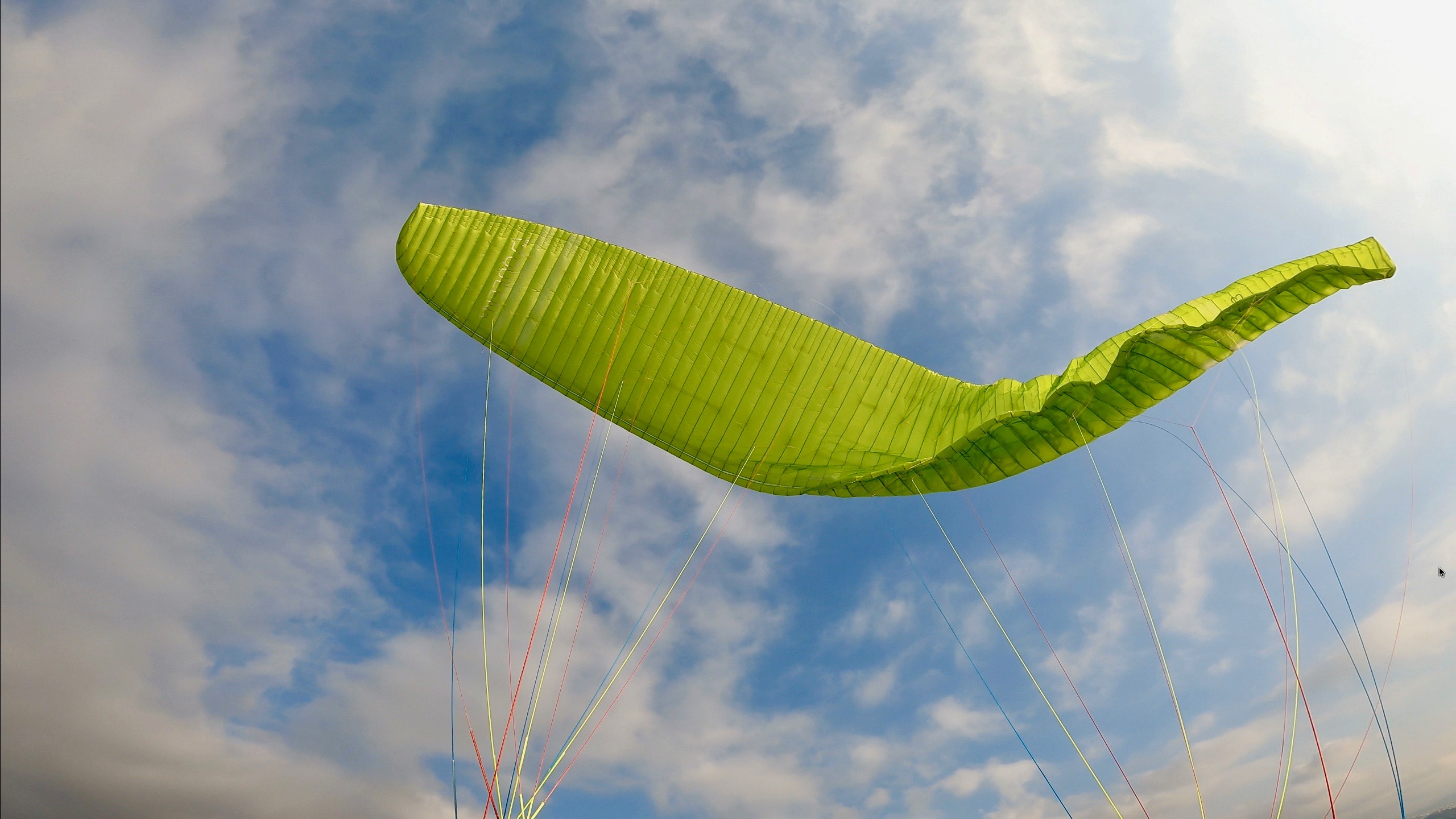
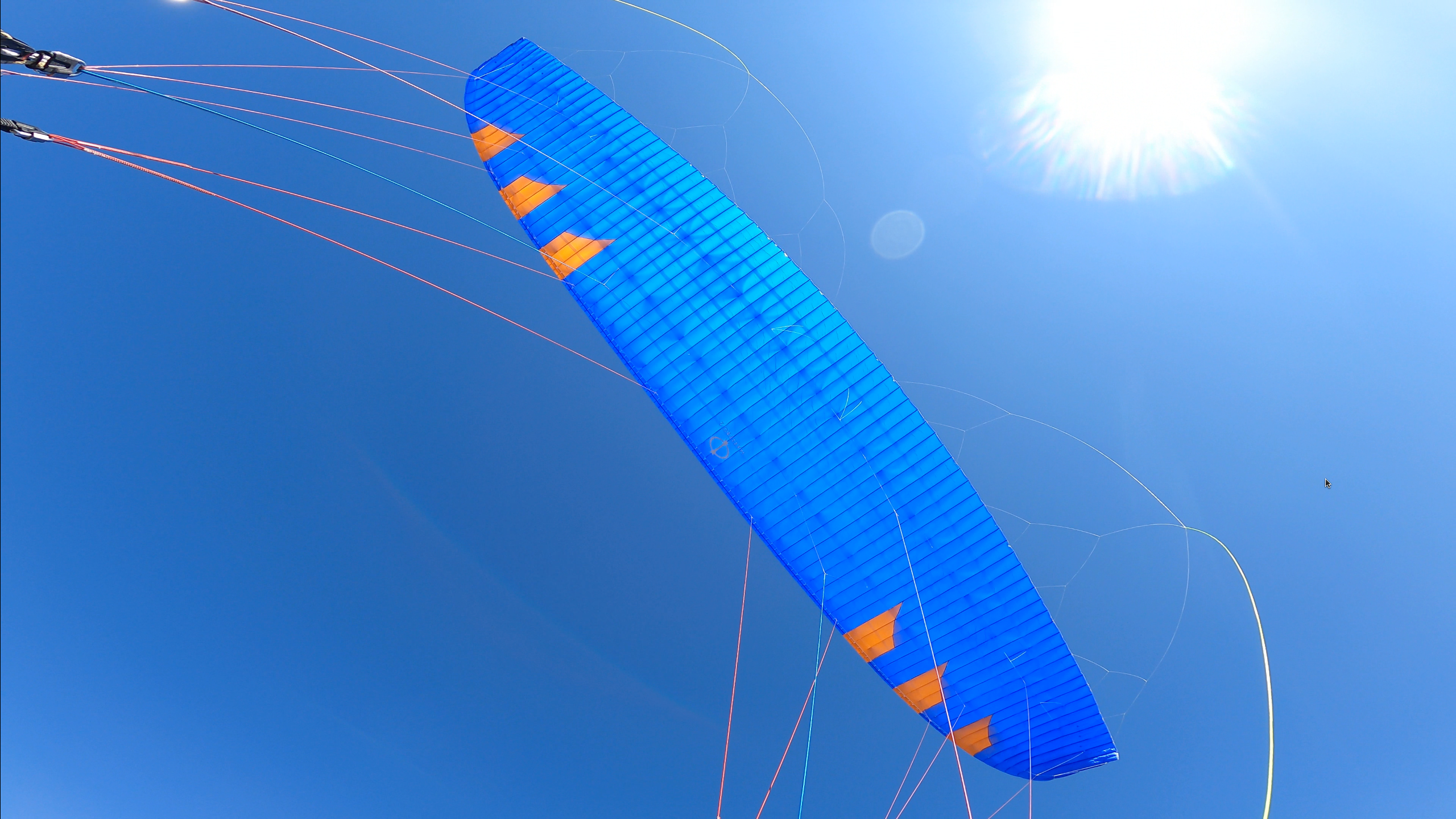
One of my preferred gliders in the C category was a Q-Light 2 S size. Handling, turning behavior, feel under it, climb rate in weak, glide, were all 90 % over 100!
Now Triple Seven introduced the Queen 3 in slightly different sizes than the older model. The SM size I’m test flying goes from 75 to 95 all up certified as a 3 liner EN-C.
Launching the Queen 3 is less than 5 km/h wind needs a few steps more in order to fill it with air, than regular C’s like Alpina 4, Elan3, Allegro…due to the small intakes on the glider.
In 25 km wind, it is easier than the mentioned gliders and slower to inflate without the surge.So what you lose when you take off in weak, you gain in windy take-offs.
I flew the Q3 with my X-rated 6 harness from 90 to 95 all up. The glider can be easily flown at 90, but to be faster when entering the airmass and to give it slightly more dynamism, flying it at 95 would be better.
The brake travel is relatively short, with probably around 10-12 cm after the 10 cm slack, you can steer the glider in moderate thermals. The Q3 needs just a slight pull to react. However the brakes are slightly harder than the Q light I had if you are flying in strong air, and you need to pull a bit more brakes around 25 cm and more.Considering that an Alpina 4 has a relatively light to moderate pressure, the Elan 3 with its moderate pressure feel, has slightly less brake pressure. But as I said the more you pull, the more pressure there is.
Flying the Q3 in moderate air, I felt that with the 15 cm gap, the brake pressure is quite normal. Some pilots prefer that solid feel that could give them a secure impression.
The first 12 cm brake range reminded me of the Artik 6 ones, while the Artik 6 has slightly less brake pressure and a bit more dynamic agility.
However, I consider the Q3 to be an agile glider similar to the Delta 4 and Alpina 4 but just very slightly slower to complete a 360 radius. The Q light 2 was quite remarkably agile and had more dynamic turning behavior than the new Q3.
I think Triple Seven wanted to create a much more accessible 3-liner C glider that can give its pilots a much higher (passive safety feel).
The feedback comes from the risers. In small punchy cores, the Q3 rolls a bit more than the Delta 4, but the pitch stays very neutral and comforting.
I flew the Q3 in various conditions, to notice that in weak thermals, the glider floats quite nicely and stays inside that weak thermal without losing it. The Q 3 is a good glider when conditions are weak and marginal. I can say it is a floater, with nice climbing properties.
Gliding in different air masses, I found that the Q3 gets inside any difficult headwind or airmass quite efficiently, but it takes time to enter. Not fast digging through, but slow and efficient.
Some 3 lines C’s would struggle a bit and lose their glide, some surges forward quickly, while the Q3 stays on hold, slows a bit, but maintain the height and slowly dig through( Itsy bitsy ;-) …) That’s why I felt that at 95 things could go slightly faster without losing the climb.
Flying while pushing the speed bar, give the Q3 a very nice glide angle, and the C steering is quite efficient. In turbulent air and while pushing at top speed, I had a few tips collapse, that opened without any reaction on my part.
Ears are stable, they reopen with a slight brake pull. Induced asymmetries resemble a B glider, smooth and slow. Pushing the bar on the Q3 gave me around +13 km at 800 ASL.
Now to explore every point on the Q3, I saw that Triple Seven made a knot on the C’s called Cowboy loop …It reduces 1 cm of the C lines. For my own curiosity, I released it first by a simple knot and second without a knot.
In a single loop, things got much better, with a nicer feel through the air in thermals, in the airmass…etc but a 10 % increase in movements.
With no loops, the (new glider) felt more alive! It turned much better and is faster through the air, but requires some 35 % more pilot control, and when accelerated some small collapses occurred. So I think, it's better to keep the knot after some 50 hours, and to explore the possibilities…
Conclusion: Triple Seven stayed with a conventional 3 liner with a 6.2 aspect ratio, for now…to prove that it flies really well, has a higher passive safety, and is easier to understand than the Queen 2. The spices of feel and handling are slightly more tamed than the Queen 2 ones, but the overall performance is surely improved.The Queen 3 is a mid-C glider in terms of feel in overall conditions.
So I think after being one full season on a Rook3, the Queen 3 is a logical evolution to stay on the safe side of the C certification.
There Maestro 2 from PHI is their latest high EN-B glider which replaces the first Maestro. In this test, I will try to write the multiple differences in comfort, performance, and handling with the Maestro1, Rush 6, Chili 5, Avid, and some other B’s also, and I will include some Ds and a comparison with a 2 liner D!
Many would ask why should he compare a high B to the latest 2-liner D’s. As the differences could be irrelevant!
My answer is well stated below in this test and I hope you enjoy reading it.
The Maestro 2 has a real aspect ratio of 5.6 and 4.1 projected. That’s quite good for keeping a good passive safety. The glider is made from Porcher/ Skytex 32-27 which is one of the best materials today. The construction and details are very neat. 76 cells on this high B, reminded me of the Nova Phantom design. The Maestro 2 is equipped with very nice and efficient RO7 risers.
The lines however are minimalistic and really thin for a high B.
No loops on the B’s or C’s…PHI most probably has made a wonderful job with those few lines. Time will tell when any change of trim will occur. My test is for a brand new Maestro 2!
Taking off in nil wind is very easy and straightforward without any delay of hard points. In fact, it is one of the easiest high B’s to inflate. In more than 25 km wind, it inflates quite fast without overshooting after an average control.
Flying the Maestro 2:
First turn, and first smile! This is a PHI! The Maestro 1, and the Allegro had a nice and direct feel. The Maestro 2 kept that beautiful feel on the brakes with a direct, agile, and linear response throughout the range!
The brake pressure has a moderate pressure until 30 cm after the 10 cm gap and it becomes slightly hard, which you probably won’t reach, as, in all my flying in strong air, you barely reach that point only in strong surges. The brakes are not tiring in turbulence when your hands are a bit low to control the glider! The pressure is less than the Chili 5 ones, slightly similar to the Rush 6 but much more linear, and similar to the Avid that I’ll review shortly. The turning behavior is really good! I could place the Maestro2 in any core even in turbulent air. The Maestro 2 brakes give the pilot the authority of command which I really appreciate!
The Rush 6 is an agile glider also, but if you pull, it turns. The Maestro 2 has a more linear and progressive pull, as you can feel every centimeter on the brakes! My weak point toward handling has been hit :-)
The agility of the Maestro 2 in coring is close to the Chili 5 but with more authority inside a core and less pressure. Gentle but agile turns can be made without the glider diving in. I could control the turning radius by the outside brakes. A delight!
In fact, I think the Maestro 2 brake feel and handling are the most beautiful found in today’s high B gliders!
It reminded me of the UP Trango Xrace with an excellent brake feel, as there’s a bit of feedback coming from the brakes also for the Maestro 2.
Going on glide under the Maestro 2:
Many pilots have told me to keep it simple…without too many explanations, just because lots of pilots wouldn’t understand the little details. But I can’t…I must be specific when it comes to (usable performance).
The first Maestro impressed me by the way it cuts through the air and moves forward. I still remember every wind glide I made and the feeling of efficiency. The Maestro 2 is even better in that matter!
The nose is always up! As it searches for the thermals in front.
I flew the Maestro 2 in some turbulent, nasty air, sometimes at + 3000 m ASL, and sometimes at 800 ASL with lots of inversions, wind, and turbulence that made me write this test with a clear conscience, that the Maestro 2 internal structure and cohesion is really tough! In those headwind conditions, the Maestro 2 nose always searches forward! That’s really an amazing feature for a high B !! category.
Flying the Maestro 2 -21 at 94 all up gave me a feeling of a fast glider. It is like I’m flying a high-rated glider in the way it moves forward, but of course, with the comfort of the B category.
I think PHI designed gliders to be flown at mid-weight which I did later at 90 all up and that didn’t alter its characteristics by getting through the airmass.
The Maestro 2 is a comfortable glider to fly! In very strong and windy air, I have pushed around quite a lot, without a tip fluttering! It is very solid and still remains above the pilot's head.
The Maestro 2 is also not dull to fly at all! The informative feedback without being too demanding is excellent. I think it is easier to fly than the Maestro 1, and also easier to fly than a brand new Rush 6. The Chili 5 and the Gin Avid are tamer but both lack that beautiful feel cutting through the airmass!
The B comparison chart is updated for details if needed.
I read on social media and perhaps some of you also did, that Hannes (the designer) told pilots to compare the Maestro 2 glide to a 2-liner! Well, that did awaken my bad habits ;-) of getting the wing tip performance comparison.
But first, I must explain that glides' wing tip to tip in still air is always very different from the same glides in moving air. Just because glider X is able to cut better inside that airmass and move forward. The other bumps into the same airmass and lose its glide.
At first, doing some glides ( similar loads and sizes) with a newly trimmed Rush 6,(reference) showed a faster top speed for the Maestro 2 by 1 km.
The quality of air penetration of the Rush 6 is now well known to many which is excellent! and can in some cases with moderate conditions glide next to higher-rated D’s.
The (Still new) Maestro 2 has even for my personal feelings, and tastes a ‘better’ gliding through the airmass as it cuts forward without slowing down!
On another day, in some booming conditions, I just saw my friend on his Trango X-race SM, with a 6.9 aspect ratio glider in front of me by 100m and at the same level, and I followed him quickly on the bar for a glide on the same line path! But…On my right, 10 meters apart was a Zeno 2 S size :-) that was also going with us on a glide. (Video soon)
After 4 km, while pushing sometimes the full bar, I reached the Tango X-race but with a +50 m for the Maestro 2!
Thanking my friend later for that glide he was very impressed by the Maestro 2 glide angle.
Now, where is the Zeno 2 :-)?
Of course, you are not waiting to see the results. are you? c’mon….
The Zeno 2 S was fully loaded and super…super fast even on the half bar! He took a different line, 30 m to the right, and arrived +300 meters ahead with around 50 meters lower. I think the Zeolite GT could be more reachable than the Zeno as a 2 liner.
Later I followed the Zeno 2 S to see more differences as I’m always curious. Following the Zeno 2, S was very hard as I was at full bar all the time to keep up. Once the conditions turn from moderate to challenging with a windy glide, the Zeno 2 is from another level. Once the air is moderate to calm, with no wind component, the Maestro 2 can keep up for the flight.
Doing some glides * In calm air * ( similar loads and sizes) with a newly trimmed Rush 6, showed a faster top speed for the Maestro 2 by 1 km. The glide is the same.
Doing glides in moving air with both gliders showed me that the Maestro 2 surges forward more to enter the same air mass.
*Your head is spinning…Lots of explanation…* :-)
Of course, the high aspect 2 liners have a much more efficient gliding through a turbulent or a moving air mass. They cut through easily and climb upward more powerfully. But “only in still air” the Maestro 2 could keep up on 60% bar while a Zeno 2 S is at 25 % with a very close glide angle.
This is only to say that the bigger differences between both will be more present in a more moving airmass facing a valley breeze ..etc…
Now doing glides with a Mantra 7 which is an EN-D glider, the Maestro 2 could keep up quite competitively thought the whole flight if the conditions.
In very weak lift and same load (-0.5 m|s) the float ability of the Mantra 7, Trango X-race, and Alpina 4, will prevail over the Maestro 2.
If loaded at the top, the climb rate in very weak conditions is slightly similar to the Rush 6. Flying it at mid-weight enhances it.
I think after 30 hours, the Maestro 2 lines will settle…And I think things could be even better in very weak. Wait and see…
Full bar delivers around +16 km/h over the trim speed, which is more than enough on this machine.
In turbulent conditions, the RO7 risers, and C control are very efficient! I could easily keep the glider overhead while on bar in turbulence. The pressure is moderate and quite satisfying.
Ears are stable. They stick even on the bar! Cool...Efficient getting down with the accelerator. They reopen quickly with pilot assistance.
The pressure on the first bar is moderate, the second is slightly hard on my X-rated6.
On full bar with pulleys overlapping, the leading edge seems still solid!
Conclusion:
Now comes Shakespeare ;-)…
One of my favorite movies is (Avatar). If you have seen it, you know what’s a * toruk makto*
With its high-performance capability, and very pleasurable (performance handling) IMHO, I consider the Maestro 2 my *toruk makto* for the B category.
And….
I think there would be some reported cases of high sensible handling pilots running away with the demo glider after landing! :-)
The Iota DLS ( Durable lightweight structure ) is an ADVANCE new high B glider with a moderate aspect ratio of 5.6.
ADVANCE used multiple mixes of Skytex in 27-32–33- 38 and 40 g | m2. The IOTA DLS is equipped with the latest Pro Dry Lines from Edelrid.
As usual, the construction is very neat all the way.
Having flown all the Iotas, the DLS felt like the most complete and well-mannered Iota to date. But that’s not all…
Launching the Iota in nil wind is very straightforward. No hard points. A slight pull and it goes evenly above your head. In strong air, the launching is also well mannered, but for sure a dab on the brakes to keep it overhead is a must for any high B glider pilot.
While test flying the Iota DLS, I had the Freedom 2 from Flow and the Rush 6 from Ozone.I spent ten full flying days, in different spots from the Cedars' strong air to the other summer spots where it was sometimes very strong, to very hot and weird… In those days I swapped between those three gliders 3 times sometimes in one day !!It was indeed a nice 10 days flying…
I will describe the differences between those 3 gliders and some more and will update my B comparison in that matter. I’m flying the 3 gliders which have the same weight range 75-95, at 93 all up with my X-rated 6 harness.
So the launching is similar to the Freedom 2 but the glider seems more taught when it rises. The R6 is much slower to inflate.
I think it resembles the Chili5 in that matter.
Once airborne,The brake travel is moderate to short that enabling a very nice turning ability.The pressure on the brakes is moderate to slightly heavy when controlling it in strong air.
They have slightly more pressure than the Freedom2, or the Rush 6 but not tiring at all. I just have to mention an exact comparison.
The brake authority on the Iota DLS is amazing! I could turn really tight with that glider. I think the Freedom 2 and the Iota DLS shares the same agility in turns with a difference in turbulent and strong air, which gives the Iota DLS better control in those tricky cores, while the Freedom 2 needs just slightly more input and resilience sometimes to stay inside that small turbulent one.It seems that the Iota DLS inner structure is very solid but also very homogenous as I could steer it quite well inside any core and which is a delight to fly!
The feel on the brakes on normal conditions favors the DLS over the R6 as they are slightly more linear. The Freedom 2 brake feel is more linear than both.
To speak about comfort, I must be precise to mention that with 30 hours on the Rush 6 it became slower and more comfortable. Some would like that! But I did re-trimmed the R6 to feel exactly like a new one.
Now the most comfortable to fly among those three is the Freedom2 followed closely by the Iota DLS which is also very comfortable to fly and last the R6 which needs slightly more input.
Now you will ask me what about the Chili5 comfort? It is still more comfortable than the three above…But will it match the performance efficiency in real XC of the DLS?let's see…
Performance:
Performance is not done in calm air at all because it doesn’t mean a thing. I do lots of glides side by side in real bumpy air just to see how much the leading edge of each glider is (behaving) in those conditions.
Does it bump? does it move forward and up? does it cut through with efficient climbing like that famous ladder effect on some hot gliders? All that talk will make some pilots say> what .. is he saying? But I am sure that most of you understand very well what I’m talking about.
Doing some glides with the Iota DLS, I was really surprised! That ADVANCE glider matches my reference B glider at trim and especially at the full bar! It rocks !!
The thing is that the leading edge behavior is amazing through the air. The pitch is nearly absent but the jump upward is surely present. The Iota DLS has the most stable pitch behavior than the R6 and F2. It resembles in that matter the Chili5 but with a much better digging through the airmass as the R6 does.
Climb rate:
I have flown it in weak air also next to the F2, and I can say it has the same climb rate capabilities. Both gliders are inseparable in weak to moderate climbs in homogenous conditions.
Steering with the rear risers is also very similar to the F2 which shares the same hand position. Using the speed bar, I could easily steer with the rear risers without any issues.
Ears are stable, they reopen without pilot intervention, but could be sped up with a dab on the brakes.
The top speed is around +1 km/h over the F2 with overlapping pulleys for both and the same flying weight.
Conclusion:
After those hours flying the Iota DLS and comparing it with my friends, then sometimes alone in those high remotes areas in our Cedars range, where any A glider feels sometimes as a leaf in those harsh conditions, I liked that version very much.It kept me in control when I needed to be, and well pressurized.
It is a well-sorted machine with top-end, B performance and efficiency in real air, that matches the top-end ones in that category to date!
The Iota DLS is IMHO, the most successful high B gliderADVANCE has yet produced.
But for sure, a demo will give you a larger idea if only you can fly it at +70 % of the weight range for a mutual understanding of my humble test.